

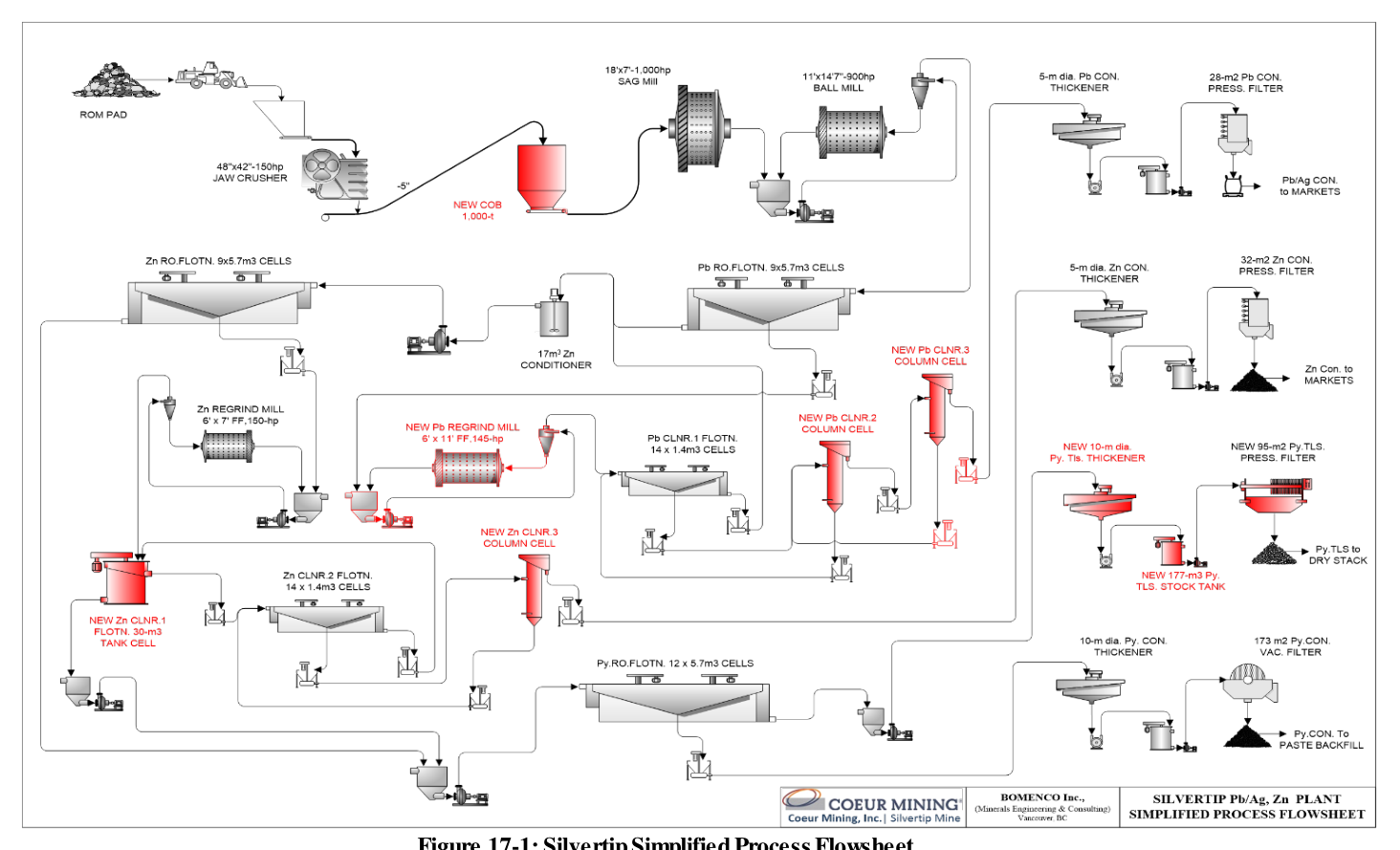
The February 2019 technical report on Coeur's Silvertip property in British Columbia describes a 1,000 t/d plant with a jaw crusher, a SAG and ball mill circuit, three-stage lead and zinc cleaning with new column cells, and a pyrite flotation circuit.
Silvertip is a silver-lead-zinc property in British Columbia, Canada. The NI 43-101 technical report has an effective date of November 1, 2018 and a report date of February 8, 2019. The current process plant design is based on 365,000 t a year of run-of-mine (ROM) ore, a nominal 1,000 t/d, on a 365 day per year operation. The process makes a lead-silver concentrate and a zinc concentrate for shipment to smelters. Tailings from zinc flotation are floated for their sulphide content, mainly pyrite, which produces a potentially acid generating (PAG) concentrate and a non-acid generating (NAG) tailings stream. Both are thickened and filtered separately. The PAG pyrite filter cake goes to the paste backfill plant in the main plant to make backfill for underground, and the NAG filter cake goes to a dry-stack tailings facility.
Critical Data
| Parameter | Value | Unit | Notes |
|---|---|---|---|
| Annual throughput | 365,000 | t/y ROM | Nominal 1,000 t/d |
| Plant design capacity | 1,064 | t/d | Design criteria |
| ROM feed grade | 5.50 / 7.00 / 200 | % Pb / % Zn / g/t Ag | Plus 18.0% sulphur |
| Crushing availability | 75 | % | 59 t/h design |
| ROM feed size | 750 | mm P80 | Product P100 150 mm |
| Coarse ore bin | 200 | t live | Between crusher and plant |
| Grinding availability | 94 | % | SAG open circuit, ball mill closed |
| SAG mill | 5,500 x 2,134 | mm | 1,000 hp |
| Ball mill | 3,350 x 4,270 | mm | 900 hp |
| SAG fresh feed | 44.3 | dmt/h | Design |
| Cyclone overflow | 150 | µm P80 | Design |
| Lead and zinc rougher cells | 9 each | 5.7 m3 | Plus 12 pyrite cells |
| Lead regrind | 25 | µm P80 | Future ball or stirred mill |
| Bond ball mill work index | 7.3 to 10.3 | kWh/mt | Range |
| Rougher residence time | 22.5 | min | Lead and zinc |
Overview
Current ore processing facilities consist of a primary crushing plant about 80 m from the main plant, which houses grinding, flotation, dewatering and paste backfill preparation. The coarse ore bin sits between the crusher plant and the main plant. Reagent preparation, utilities, a maintenance shop, offices and the metallurgical and assay laboratories are in the same building. An operational and metallurgical review and the 2017/2018 test programs on ore from underground stopes identified substantial improvements to the flowsheet and equipment, to raise operating availability and product quality while maximizing production.
Key Process Stages
Crushing
An 80 t dump hopper feeds a 1220 by 1067 mm jaw crusher with a 150 hp motor through a reciprocating feeder, and a conveyor takes the product to a 200 t coarse ore bin. A reclaim feeder and a SAG feed conveyor then feed the grinding circuit.
Grinding
The circuit configuration is a SAG mill in open circuit and a ball mill in closed circuit with cyclones. The SAG mill is 5,500 mm in diameter by 2,134 mm, with 1,000 hp, and the ball mill is 3,350 mm by 4,270 mm, with 900 hp. Cyclone overflow is designed at 150 µm P80. The ore is relatively soft, with a Bond ball mill work index of 7.3 to 10.3 kWh/mt and a low Bond abrasion index of 0.052 to 0.082 g.
Lead flotation
Lead roughers are nine 5.7 m3 cells with a 22.5 minute residence time and a concentrate mass pull of 21% of lead rougher feed. Rougher concentrate is reground to 25 µm P80 in a 1,830 by 3,350 mm regrind mill, with a ball or stirred mill as a future option. The first cleaner has fourteen 1.4 m3 cells, and the second and third cleaners are new column cells, 2.1 m in diameter and 6 m high. The three cleaners run counter-current, and rougher and first cleaner tails go to zinc roughing.
Zinc flotation
A conditioning tank gives 4.0 minutes of conditioning ahead of nine 5.7 m3 zinc rougher cells. Zinc cleaning has a new 30 m3 tank cell for the first cleaner, fourteen 1.4 m3 cells for the second, and a new 2.5 m by 6 m column cell for the third. A zinc regrind mill of 1,830 by 2,134 mm works with a cyclone cluster. Rougher and first cleaner tails go to pyrite flotation.
Pyrite flotation and dewatering
Twelve 5.7 m3 cells float pyrite. The pyrite concentrate is thickened in a 10 m thickener and filtered on a 173 m2 disc filter, and the tails are thickened in a 5 m thickener and filtered in a 95 m2 filter press. Lead and zinc concentrates have their own 5 m thickeners and pressure filters, 28 m2 for lead and 32 m2 for zinc, and a lamella clarifier serves the lead circuit. Tailings pond reclaim water is recycled as process make-up water.
Additional Interesting Data and Summary
Paste backfill is made with two 600 hp pumps, a mixer and a 3,000 mm diameter cement silo. The equipment list also includes a flotation air blower, two plant air compressors and a 757 m3 process water tank.
The design criteria use SMC test values of 4.3 kWh/mt for crushing, 12.3 for coarse grind and 9.0 for fine grind, and an A*b of 69.
Key Processes
- Jaw crushing and coarse ore storage
- SAG mill in open circuit with a closed circuit ball mill
- Lead rougher flotation with regrind and three-stage cleaning
- Zinc rougher flotation with regrind and three-stage cleaning
- Pyrite flotation of zinc tailings into PAG and NAG streams
- Thickening and filtration of concentrates and tailings
- Paste backfill and dry-stack tailings disposal
Source: Technical Report for the Silvertip Property, British Columbia, Canada, NI 43-101 Technical Report, February 8, 2019.
Project website: Silvertip Property
