

The March 2013 technical report on Coeur's Endeavor mine near Cobar, Australia describes a differential flotation mill rated at 1.3 Mtpa that runs well below capacity, with an unused copper circuit and rail shipment to Newcastle and Port Pirie.
Endeavor is a lead, zinc and silver mine near Cobar, New South Wales, Australia, covered by a Technical Report dated March 28, 2013 for Coeur d'Alene Mines Corporation, prepared by Donald F. Earnest of Resource Evaluation Inc. The Endeavor mill is a conventional grinding and differential flotation mill, originally designed to treat about 1.1 million tonnes of ore a year to make separate lead and zinc concentrates. In March 2008 a pebble rejection system was installed to remove oversize material from the AG mill, and a tertiary ball mill was commissioned in June 2008. These upgrades lifted plant capacity to 1.3 Mtpa, which could be pushed as high as 1.6 Mtpa with further optimization. Current and forecast ore production of 720,000 tpa falls well short of mill capacity, causing frequent plant shutdowns for lack of ore.
Critical Data
| Parameter | Value | Unit | Notes |
|---|---|---|---|
| Original design capacity | 1.1 | Mtpa | Lead and zinc concentrates |
| Upgraded capacity | 1.3 | Mtpa | Possibly 1.6 Mtpa |
| Forecast ore production | 720,000 | tpa | Below mill capacity |
| Crushed ore size | 165 | mm P80 | Two primary jaw crushers |
| Live stockpile | 10,000 | t | Four vibrating feeders |
| AG mill | 7.3 x 2.44 | m | Optional 8% charge of 125 mm balls |
| AG mill feed | 80 to 200 | t/h | Depends on ore availability |
| AG mill discharge | 40 | % passing 45 µm | Open circuit |
| Cyclone overflow | 80 | % passing 95 µm | Screened for trash |
| Lead rougher cells | 2 banks x 9 | x 8.5 m3 | Last three of each bank scavenge |
| Lead concentrate grade | 50 | % Pb | After three cleaning stages |
| Zinc final concentrate target | 50 | % Zn | Budget |
| Regrind mills | 185 | kW | Lead and zinc sand mill |
| Lead and zinc concentrate moisture | 7 / 10 | % | Pressure filters |
| Concentrate storage | About 7,000 | t | Shed |
| Silver recovery | 43.6 to 54.0 | % | Since 1999 |
Overview
The complex metallurgy of Endeavor ores makes efficient separation of lead and zinc products difficult. The mineralization is fine grained, with lead and zinc minerals associated with a similarly fine-grained iron sulphide matrix, so fine grinding is required to liberate the metal-bearing sulphides. Even at a finer grind, the performance of different ore types varies widely, so underground production is blended to give a more uniform mill feed. Only silver that reports to the lead concentrate is payable, although a minor amount reports to the zinc concentrate.
Key Process Stages
Crushing and primary grinding
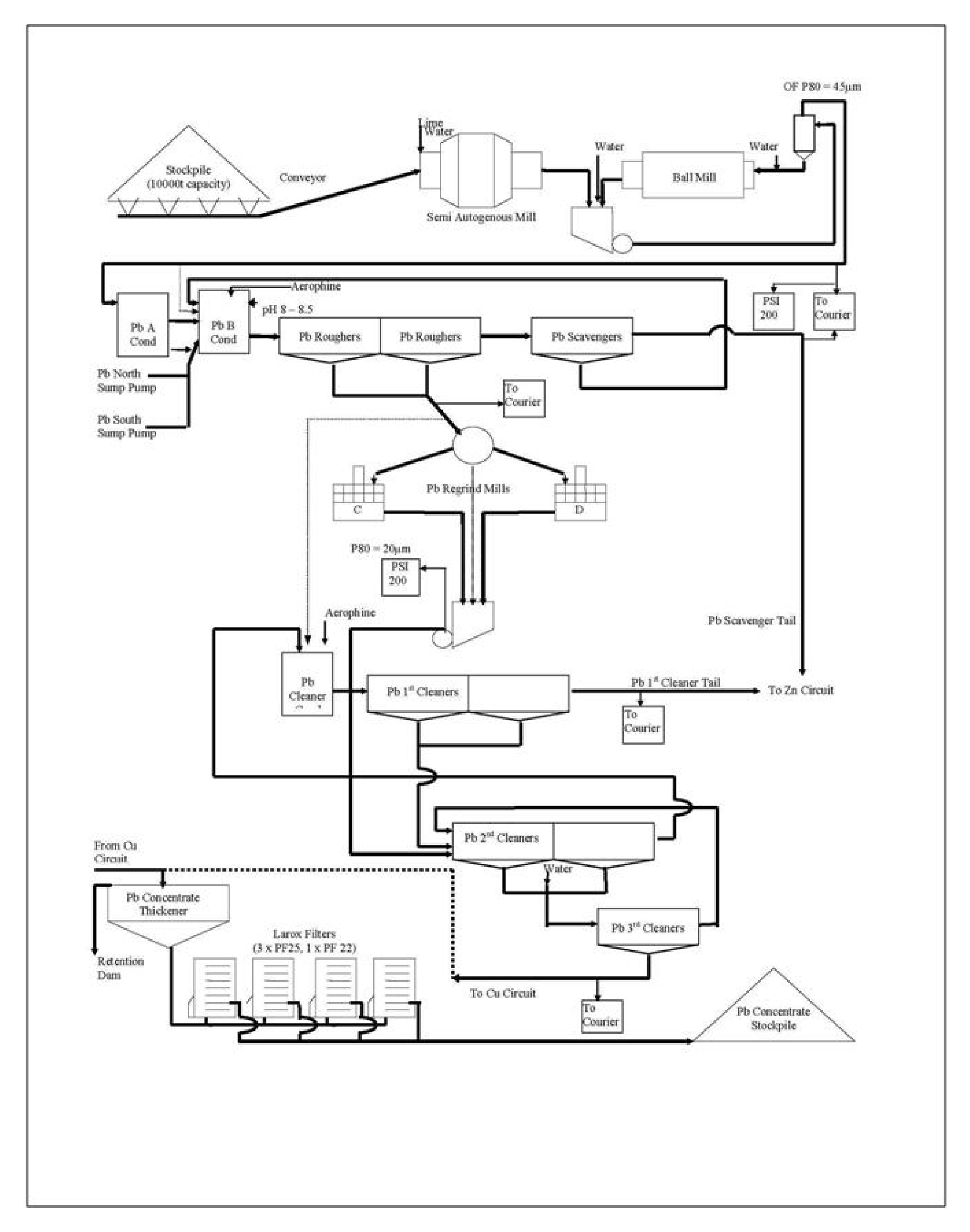
Ore is crushed to 80% passing 165 mm in two primary jaw crushers, located both underground and on the surface. It comes up by truck on the main haulage decline or is crushed on the 3 Haulage level and hoisted to a 10,000 t live stockpile. Four vibrating feeders send it to a two-stage grinding circuit. A 7.3 m by 2.44 m fully autogenous mill, which can run as a semi-autogenous mill with up to 8% of 125 mm balls, takes 80 to 200 t/h in open circuit. Its discharge goes to two sequential ball mill circuits in closed circuit with Warman Cavex cyclones. Cyclone overflow is screened to remove trash such as shotcrete fibres before it goes to flotation.
Lead flotation
Overflow goes to two continuous conditioning tanks, with lime, Aerophine and frother as reagents, and two parallel banks of nine 8.5 m3 rougher cells, the last three of each bank acting as scavengers. Rougher concentrate is reground in a 185 kW mill before three stages of cleaning in two parallel banks of six 5.7 m3 cells, followed by re-cleaning in a bank of five 5.7 m3 cells and three 2.8 m3 cells. The lead concentrate grade is 50% Pb. Second cleaner tails return to the front of the first cleaner and the third cleaner tail returns to the second cleaner. The scavenger concentrate returns to the second conditioning tank. Lead scavenger tail and first cleaner tail feed zinc flotation.
Zinc flotation
Two conditioning tanks add lime for pH control, copper sulphate to activate sphalerite and a sulphonate as an iron depressant, with sodium isopropyl xanthate and Powercon as other reagents. Open-circuit roughing and scavenging use two parallel banks of nine 8.5 m3 cells. Rougher concentrate is reground in a 185 kW sand mill, then cleaned in three stages to reach a budget final concentrate grade of 50% zinc. Scavenger concentrate returns to the second conditioning tank, and scavenger tails and first cleaner tails go to the final tails thickener. The copper flotation circuit, installed in 2008, is not in use.
Dewatering, storage and tailings
Lead concentrate passes a 25 m thickener and a pressure filter to 7% moisture, and zinc concentrate is dewatered similarly to 10%. Concentrates are stockpiled in a shed of about 7,000 t capacity and loaded by front-end loader into covered rail cars. Zinc concentrate goes to the CBH-owned Newcastle ship loader and lead concentrate to the Port Pirie smelter owned by Nyrstar in South Australia. Tailings are thickened in a 50 m thickener and pumped to the tailings storage facility. Dried tailings were reclaimed for paste fill in the 2009/2010 year until underground paste filling was curtailed in 2011. All process water, runoff and mine water is recycled in the concentrator.
Additional Interesting Data and Summary
Mill performance in calendar 2012 fell short of budget for tonnes, recoveries and feed grade, except zinc feed grade. During CBH's tenure, average annual mill head grades for silver have fluctuated between 32 and 78 g/t, with 54 g/t in 2003/2004 and 42 g/t in 2004/2005. Overall payable silver production is further reduced by smelting charges of $2.25 per kg of silver.
Process plant recovery of silver has ranged from 43.6% to 54.0% since 1999.
Key Processes
- Two-stage jaw crushing underground and on surface
- Autogenous milling with pebble rejection and two ball mills
- Lead rougher, scavenger and three-stage cleaner flotation
- Zinc activation, rougher, scavenger and three-stage cleaner flotation
- Regrinding of lead and zinc rougher concentrates
- Thickening and pressure filtration of concentrates
- Rail shipment to Newcastle and Port Pirie
Source: Endeavor Mine, Cobar, New South Wales, Australia, Technical Report, March 28, 2013.
