

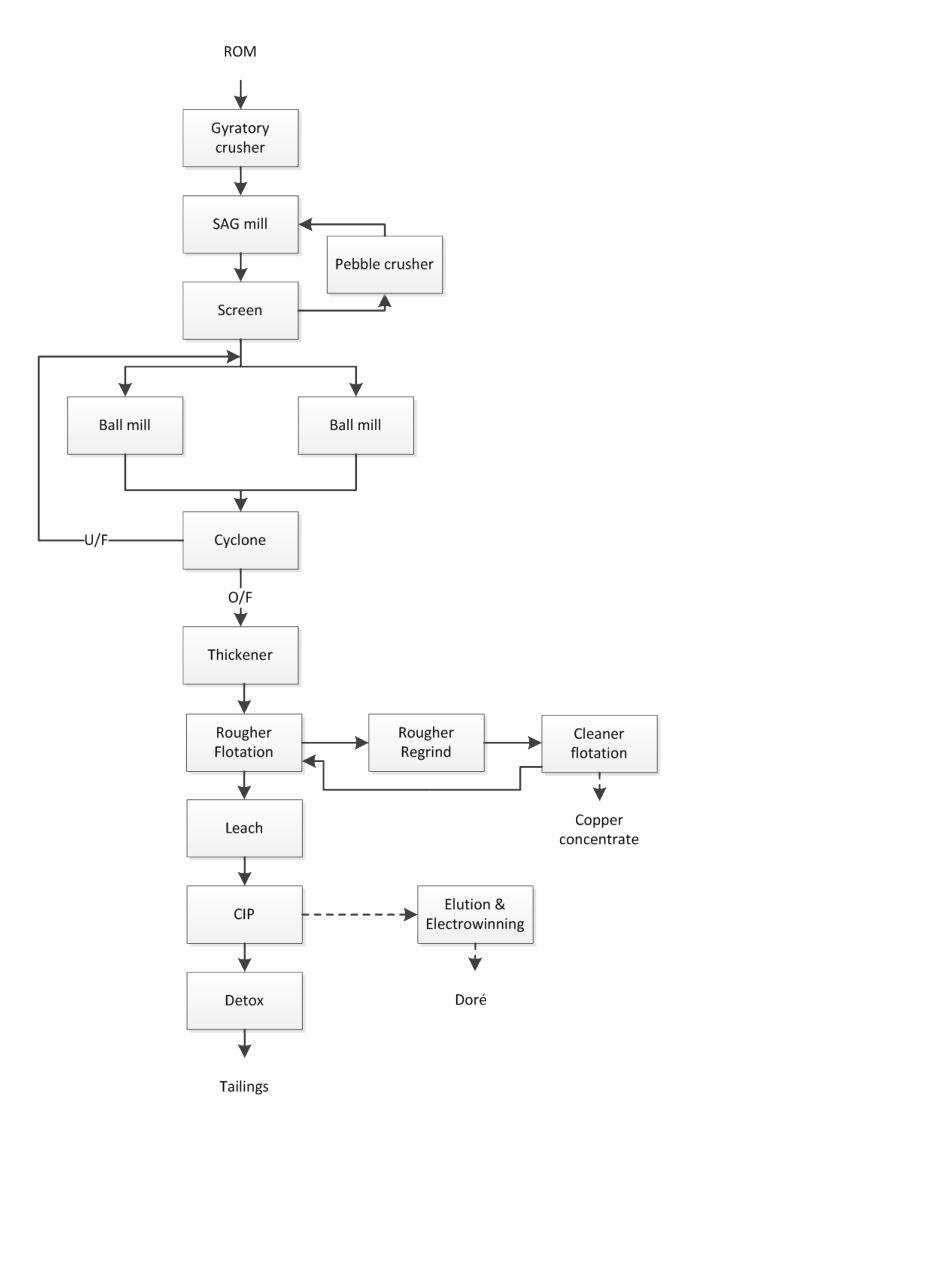
The May 2015 revised flotation PEA for Ecuador Gold and Copper's Santa Barbara project in southeast Ecuador sizes a 10 Mt/y plant with a gyratory crusher, a 9 MW SAG mill, two 16 MW ball mills and an 86 m thickener.
The Santa Barbara Gold and Copper Project lies in the Zamora-Chinchipe province of southeast Ecuador, close to the Peruvian border. GBM Minerals Engineering Consultants prepared the NI 43-101 Technical Report and Preliminary Economic Assessment for Ecuador Gold and Copper Corp., with an effective date of May 19, 2015 and a signing date of May 29, 2015. The metallurgical process was developed from testwork and the production schedule, and indicates that conventional flotation and cyanide leaching could be used to recover copper, gold and silver from the feed material. The design throughput is 10,000,000 t/y. Copper recovery is 80%, gold recovery 86.7% and silver recovery 20%. Gold recovery improved with finer grinding in testwork, so the study selected a final grind of 80% passing 75 µm.
Critical Data
| Parameter | Value | Unit | Notes |
|---|---|---|---|
| Annual throughput | 10,000,000 | t/y | 365 days a year |
| Crushing feed rate | 1,522 | t/h | 75% availability |
| Milling feed rate | 1,241 | t/h | 92% availability |
| ROM specific gravity | 2.80 | t/m3 | Not applicable |
| Primary grind | 75 | µm | Cyclone cut size |
| Regrind | 10 | µm | IsaMill |
| Copper recovery | 80 | % | Flotation |
| Gold recovery | 86.7 | % | Silver 20% |
| Cyanide / lime use | 1 / 0.5 | kg/t | Not applicable |
| Primary crusher product | 350 | mm | Gyratory |
| SAG mill | 9 | MW | Product 100% passing 10 mm |
| Ball mills | 2 x 16 | MW | Two hydrocyclone clusters |
| Thickener | 86 | m | Concrete |
| Leach tanks | 6 | tanks | 3,073 m3 each |
| CIP circuit | 7 | stages | 3.5 hours, 768.3 m3 per tank |
| Detoxification tanks | 2 | tanks | 1,721 m3 each |
Overview
The flowsheet crushes and mills the feed, floats a copper concentrate, and leaches the flotation tailings for gold. Rougher concentrate is reground to 10 µm and cleaned. Rougher and cleaner tailings go to pre-leach conditioning, then to six leach tanks and a seven-stage carbon-in-pulp (CIP) circuit. Loaded carbon goes to acid wash, elution and electrowinning, and leached slurry is detoxified and pumped to the tailings management facility (TMF). The report states that equipment was selected on a non-optimised preliminary design basis.
Key Process Stages
Crushing and stockpile
Haul trucks dump into a ROM bin or onto a transition ROM stockpile, and a front-end loader tops up the bin when trucks are not arriving. A rock breaker handles boulders. The primary crusher tower is sited to suit topography, about 15 m below the ROM pad. A primary gyratory crusher reduces feed from 100% passing 600 mm to 350 mm, chosen over sizers and multiple jaw and cone crushers for its throughput and large top size. A 450 m conveyor carries the product across the Yapi River to a 110 m diameter coarse stockpile with 24 hours of live volume. Three vibrating feeders, each sized for 280 t/h, reclaim to a 140 m conveyor.
Grinding
A 9 MW SAG mill grinds to 100% passing 10 mm, and discharge is screened, with oversize pebbles crushed by a cone crusher sized for about 10% of SAG feed and returned. Cyclone underflow feeds two 16 MW ball mills in closed circuit with two hydrocyclone clusters cutting at 75 µm. Overflow passes a leach feed trash screen and a single sampler before an 86 m diameter concrete thickener, whose underflow is pumped to the first agitated flotation conditioning tank.
Flotation and regrind
Mechanically agitated flotation tanks generate a copper concentrate under conditions set to maximize recovery. Rougher tailings go to a rougher scavenger and then to the CIP leach circuit. Rougher and rougher scavenger concentrates are reground in an IsaMill to 10 µm P80, in closed circuit with hydrocyclones that receive the feed so that only oversize goes to the mill, minimizing overgrinding. Reground material is conditioned and cleaned in another bank, and cleaner tailings return to the rougher circuit.
Leaching and CIP
Testwork showed preg robbing is minor, so the study selected CIP over carbon-in-leach, which also reduces carbon inventory and maximizes loading. Two agitated pre-leach tanks of 3,073 m3 receive lime and sparge air to cut cyanide consumption. Six agitated leach tanks of the same size follow, with cyanide added to the first and lime to the first two, and all tanks are sparged with low pressure air. Launders cascade the slurry to the CIP circuit. CIP tanks of 768.3 m3 have inter-tank vibrating screens and a carousel configuration, where carbon stays in one tank until it is taken offline, so no carbon is transferred between tanks. A carbon safety screen catches fine carbon.
Gold recovery and detoxification
An acid wash and elution package handles about 8 t of loaded carbon a day. Carbon is washed with hydrochloric acid, rinsed, and stripped with sodium cyanide and caustic at elevated pressure and temperature. Pregnant solution goes to electrowinning in the gold room, where cathodes are pressure washed, the sludge is filtered, dried, fluxed and smelted in an induction furnace to make doré. A horizontal kiln regenerates up to 8 t of carbon a day, and the carbon is quenched and returned to the last CIP tank. Tailings go to two detoxification tanks dosed with sodium metabisulphite, copper sulphate and slaked lime, and then to the TMF.
Additional Interesting Data and Summary
Power comes from the hydroelectrically generated grid, with installed power of 75 MW and a site power factor of 0.8. The gold room would be enclosed for security and needs ventilation fans and ducts. The report says the crushing and milling circuit depends heavily on the characteristics of the mineralized material, which have had little testwork, and that further tests are needed on amenability to crushing and milling. Crusher selection assumed the material was hard and highly abrasive.
The two detoxification tanks are preliminary and need confirmation by future testwork. The site water balance used regional meteorological data and the mass balance, starting with process plant requirements.
Key Processes
- Gyratory crushing
- SAG and ball mill grinding in closed circuit with cyclones
- Copper rougher, scavenger and cleaner flotation
- IsaMill regrinding to 10 µm
- Pre-leach conditioning and six-tank cyanide leaching
- Carousel carbon-in-pulp adsorption
- Acid wash, elution and electrowinning
- Cyanide detoxification before tailings disposal
Source: NI 43-101 Technical Report Preliminary Economic Assessment of the Santa Barbara Gold and Copper Project in Zamora, Ecuador, May 29, 2015.
