

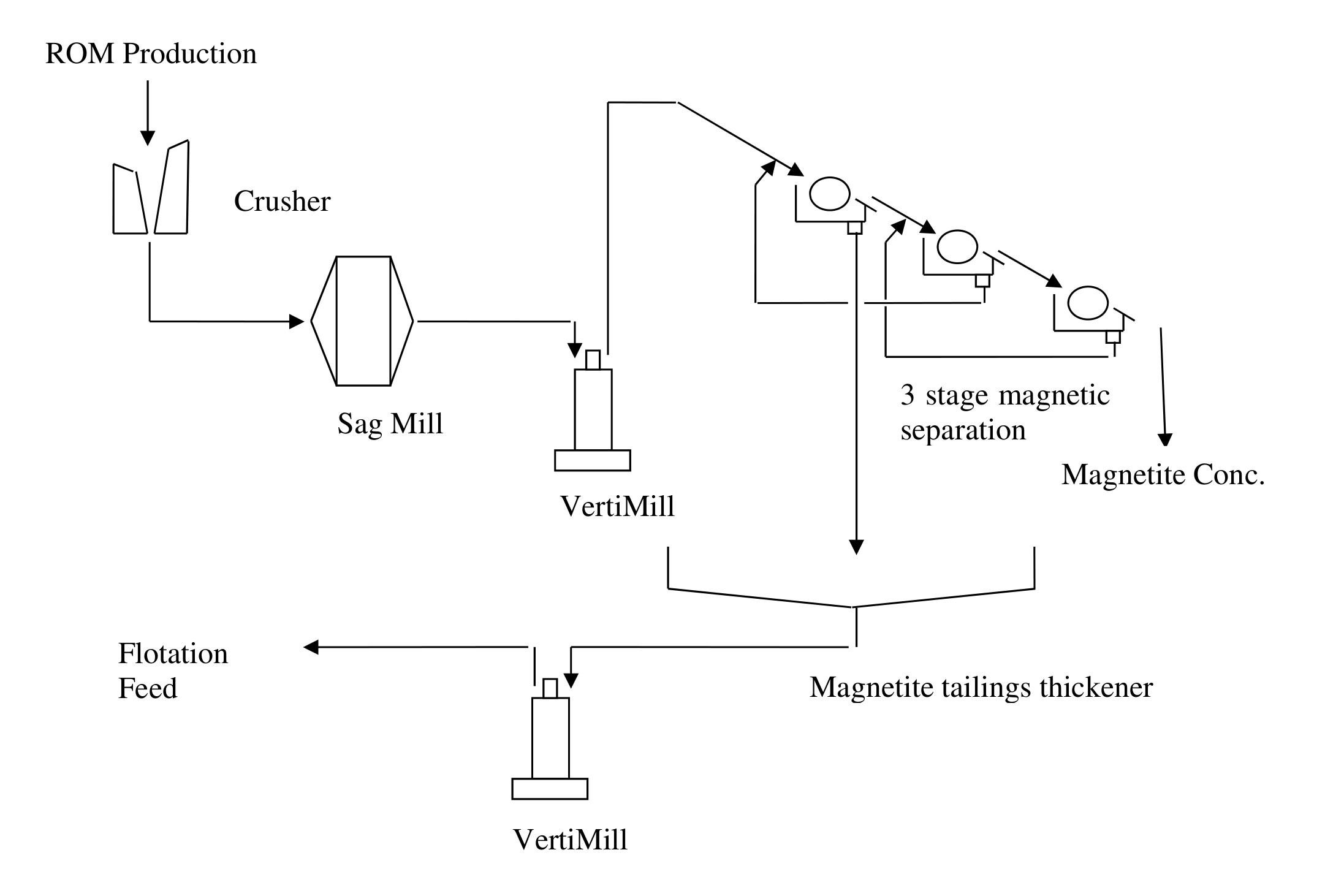
Mine Development Associates' May 2014 preliminary economic assessment for InZinc's West Desert project in Utah recovers about half of the feed mass as a 64% iron magnetite concentrate before floating 29% copper and 55% zinc concentrates.
The West Desert project is a zinc-copper-indium-magnetite deposit in Juab County, Utah, held by InZinc Mining Ltd., formerly Lithic Resources Ltd. The project was formerly called Crypto. Mine Development Associates (MDA) prepared the Technical Report on the West Desert Preliminary Economic Assessment, with an effective date of March 17, 2014 and a report date of May 2, 2014. The concentrator is designed for 6,500 t/d of underground mine production, about 2.4 million tonnes a year. It makes an iron concentrate by magnetic separation, plus two flotation concentrates, copper and zinc. The proposed processes are traditional, and all testwork on West Desert material points to a conventional copper and zinc differential flotation process. The report notes that "ore" is used in a metallurgical sense and does not imply economic analysis.
Critical Data
| Parameter | Value | Unit | Notes |
|---|---|---|---|
| Annual throughput | 2,372,500 | t/y | 6,500 t/d |
| Crusher availability | 67 | % | Underground station |
| Mill availability | 92 | % | 294 t/h SAG feed |
| Average mine grade | 44.02% magnetite | Not applicable | 0.27% Cu, 2.72% Zn |
| Design grade | 47.4% magnetite | Not applicable | 0.25% Cu, 2.44% Zn |
| Magnetite recovery | 97 | % | 64% Fe concentrate |
| Copper recovery | 74 | % | 29% Cu concentrate |
| Zinc recovery | 92 | % | 55% Zn concentrate |
| Primary grind | 65 | µm P80 | Magnetite plant feed |
| Copper regrind | 15 | µm | 100 kW stirred mill |
| Zinc regrind | About 30 to 35 | µm | 500 kW stirred mill |
| Underground crusher | 36 in x 48 in | Not applicable | 500 m below surface |
| Conveyor | 4.8 | km | Two 2.4 km conveyors |
| Live stockpile | 8,200 | t | About 30 hours |
| Copper concentrate | 1.7 | t/h | Average |
Overview
Run-of-mine ore is crushed underground to about 250 mm and carried by conveyor to a surface stockpile. A SAG mill and a vertical stirred mill grind it to 65 µm, and magnetite is recovered by drum separators before flotation, so that flotation feed is about half the plant tonnage with roughly twice the copper and zinc grade. Copper is floated first with zinc depressed, and zinc is floated from the copper tailings after activation. Concentrates are thickened and filtered for shipment to the respective smelters.
Key Process Stages
Crushing and conveying
A 36 in by 48 in jaw crusher with an 8 in closed setting sits about 500 m below surface. An inclined conveyor of about 4.8 km, made up of two conveyors of about 2.4 km each, moves crushed material to a live stockpile next to the mill. The 8,200 t stockpile holds about 30 hours of mill feed.
Grinding
Two apron feeders reclaim material onto a SAG mill feed conveyor at 294 t/h. The SAG mill is 22 ft in diameter by 11 ft EGL with a 3,000 hp drive and carries 15% by volume of 150 mm forged steel balls. Screen underflow goes to a cyclone feed pump, and the primary cyclones target a P80 of 65 µm. Cyclone underflow feeds a VTM 3000 vertical stirred mill with a 3,000 hp motor at a 250% circulating load. Cyclone overflow at 35 to 38% solids goes to magnetite recovery.
Magnetic separation
Three 48 in by 124 in low-intensity drum separators at 900 gauss work in parallel as roughers, then two cleaner stages each use two identical separators. Large volumes of dilution water remove entrained gangue, and cleaner tailings move counter-current in the process. Magnetite tailings go to a thickener that recovers water for the cleaning stages and improves reagent use in flotation.
Copper flotation
Flotation feed is thickened to about 40% solids in a 60 m conventional thickener. Underflow goes to a 1,500 hp vertical stirred mill with a cyclone, which targets 50 to 60 µm. Lime holds pH at 9.0 to 10.0, and zinc sulphate and sodium cyanide depress zinc. Five 20 m3 mechanical cells provide about 16 minutes, and five 2 m3 cleaners upgrade the rougher concentrate. The concentrate is reground to about 15 µm and cleaned in two counter-current flotation columns of 2.5 ft diameter and 30 ft height.
Zinc flotation
Copper tailings are conditioned in two tanks of 4 m by 6 m with 5 kW agitators in series, with pH raised to 11.0, lime and copper sulphate in the first tank and collectors in the second. Eight 20 m3 cells give about 24 minutes of roughing, and eight 5 m3 cells clean the concentrate. First cleaner concentrate is reground to about 30 µm in a 500 kW stirred mill with a classifying cyclone, then goes to two columns of 2.5 m by 10 m as second and third cleaners. Rougher and first cleaner tailings go to the tailings storage facility.
Concentrate dewatering
Magnetite concentrate is dense enough to go directly to a belt vacuum filter. Copper concentrate is thickened to about 75% solids in a 6 m thickener with flocculant, held in an agitated tank and filtered on a pressure filter. Zinc concentrate is thickened to about 75% solids in a 20 m thickener and filtered. Concentrates are stored indoors before loading on highway trucks.
Additional Interesting Data and Summary
Tailings are pumped to a storage facility, and water is reclaimed with a barge-mounted pump to a process water tank. Reagents are mixed and metered from a dedicated area using metering pumps. The plant has compressed air, fresh water and instrument air, a process-control system with extensive field instrumentation, and an on-stream analyzer to monitor flotation.
The design does not consider large variations in feed grade or metal ratios. For ores with enough copper to justify recovery, zinc depressants are added to the grinding mill to limit zinc going to the copper rougher concentrate. The report states that sufficient testwork has been done to allow a preliminary design.
Key Processes
- Underground jaw crushing and long-distance conveying
- SAG and vertical stirred mill grinding
- Three-stage low-intensity magnetic separation
- Copper flotation with zinc depression
- Zinc flotation after copper sulphate activation
- Column flotation cleaning
- Concentrate thickening and filtration
Source: Technical Report on the West Desert Zinc-Copper-Indium-Magnetite Project, Preliminary Economic Assessment, Juab County, Utah, May 2, 2014.
