

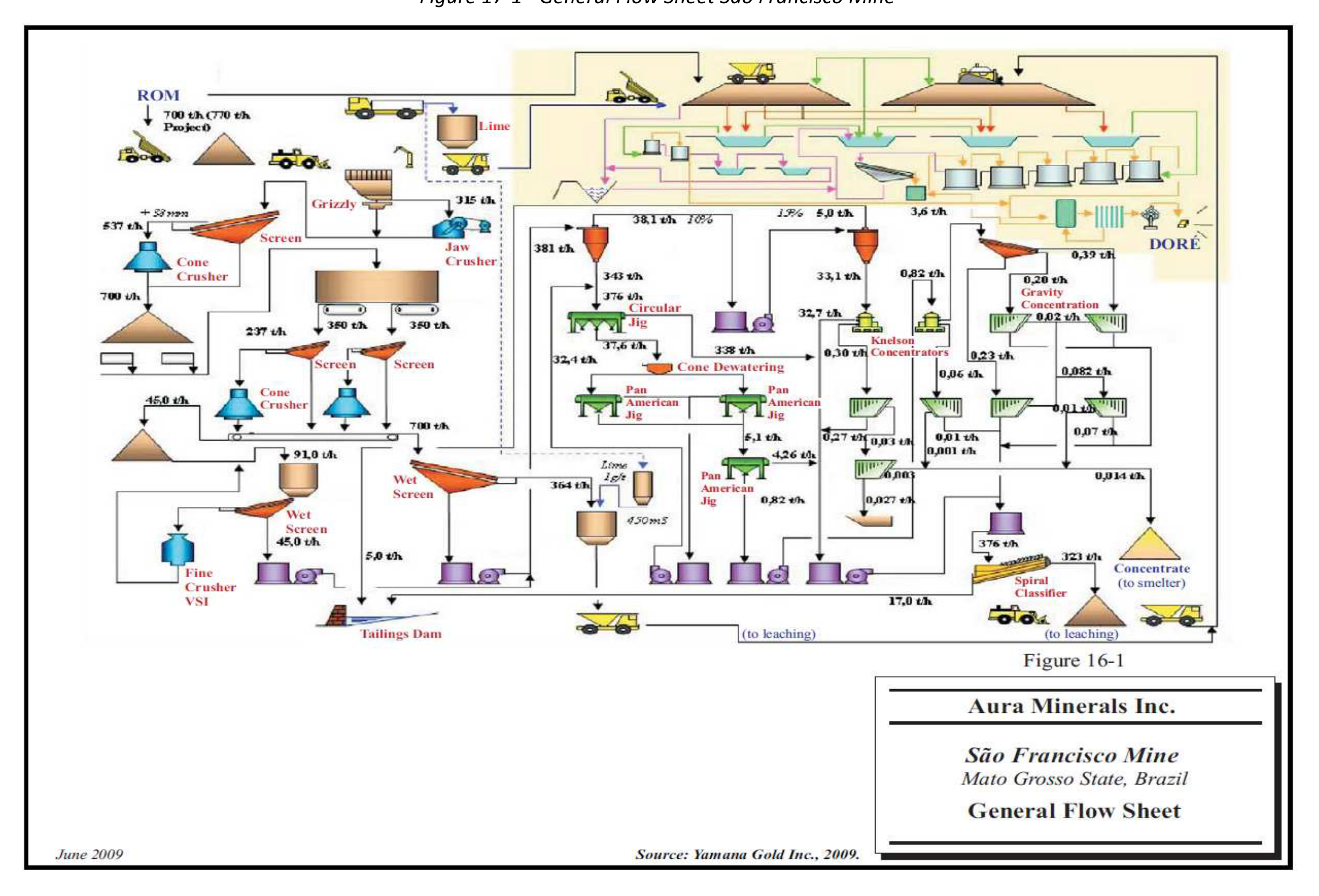
The January 2012 technical report on Aura Minerals' São Francisco mine in Mato Grosso, Brazil describes a plant that processed about 2.1 million tonnes in 2011, sending 30% of crushed ore to gravity and 70% with gravity tails to the leach pads.
São Francisco is a gold mine in the municipality of Vila Bela da Santíssima Trindade, in the State of Mato Grosso, Brazil, owned by Aura Minerals Inc. The NI 43-101 technical report on resource and reserve estimates is dated January 31, 2012 and has an effective date of September 30, 2011. The mineral processing system consists of a gravity concentration circuit combined with a multi-lift heap leach operation. High-grade ore, called CGO, is processed by crushing and gravity concentration, followed by heap leaching of the tailings product from the gravity circuit. The crushing circuit has three stages and is designed to produce a product with 30% passing less than 6.0 mm to feed the gravity circuit, while the remaining 70% goes to the leach pads with the gravity tails.
Critical Data
| Parameter | Value | Unit | Notes |
|---|---|---|---|
| Ore processed in 2011 | About 2.1 | million tonnes | Between April and September |
| 2011 plant production | 2,168,303 | t at 0.61 g/t Au | 31,542 oz gold recovered |
| Sub-marginal grade | 0.15 to 0.25 | g/t Au | Stockpiled separately |
| Low grade | 0.25 to 0.40 | g/t Au | Stockpiled separately |
| CGO or high grade | Above 0.40 | g/t Au | Crushed and gravity treated |
| Crushing design feed | 850 | tph | 90% operational efficiency |
| Jaw crusher setting | 6 1/2 | in CSS | Primary |
| Secondary cone setting | 1 1/4 | in CSS | Secondary |
| Tertiary cone setting | 1/2 | in CSS | Two crushers in parallel |
| Gravity circuit capacity | 457 | tph | 83% operational efficiency |
| Gravity recovery | 60 | % | Estimated |
| Jig circuit feed | 343 | tph | Design |
| Liner | 1.5 | mm | Geo-membrane on leach pad |
| ADR facility capacity | 2,125 | m3/h | 90% operational efficiency |
| Overall recovery to doré | 78 | % | Estimated |
| Carbon columns | 5 | Not applicable | Cascade-type, open-top up-flow |
Overview
Ore is crushed in three stages. The tertiary screen undersize feeds a gravity circuit of hydrocyclones, jigs, centrifugal concentrators and shaking tables. Tertiary screen oversize passes a silo where lime is added and is hauled by truck to the heap leach pad. Gravity concentrate goes directly to the smelter. The coarse product of the gravity circuit's spiral classifier is hauled to the heap leach. Leach solution is collected in a pregnant solution pond and treated in a carbon adsorption, desorption and recovery (ADR) plant. Gravity concentrates and loaded cathode material are combined and smelted to doré.
Key Process Stages
Crushing
ROM ore passes a fixed grizzly, and a hydraulic rock breaker is available for oversize. Grizzly undersize is fed by a vibrating feeder to a jaw crusher with a closed side setting of 6 1/2 inches, and a belt conveys its product to a primary two-deck screen. Oversize goes to a secondary cone crusher at 1 1/4 inch, and the primary screen undersize joins the secondary product in a stockpile. A small feed bin feeds two secondary two-deck screens in parallel, whose oversize feeds two tertiary cone crushers at 1/2 inch in parallel. Secondary screen undersize combines with tertiary crusher product and goes to a wet tertiary two-deck screen. The circuit has a design feed rate of 850 tph at 90% operational efficiency.
Gravity circuit
The gravity circuit is fed by tertiary screen undersize and starts with a hydrocyclone. Underflow feeds a jig circuit at a design 343 tph, with eight circular primary jigs followed by two Pan American secondary jigs in parallel and a tertiary Pan American jig. Secondary jig tailings return to the primary circular jig. The tertiary jig concentrate goes to a coarse gravity recovery circuit with a centrifugal concentrator and a shaking table. The fines circuit has a centrifugal concentrator, fed by secondary hydrocyclone underflow at 33 tph, and a series of shaking tables. The primary hydrocyclone overflow feeds the secondary hydrocyclone at 38 tph. Combined tailings go to a spiral classifier, whose coarse product is hauled to the heap leach while its slime overflow and the hydrocyclone overflows go to the tailings dam. The products of the fines and coarse gravity circuits are concentrates sent directly to the smelter.
Heap leach
Crushed ore is stacked by trucks and track dozers on a multi-lift, single-use leach pad. The pad has a compacted soil sub-base, a 1.5 mm geo-membrane liner, a cushion layer and perforated plastic drainpipes placed under the cushion layer during stacking to collect leach solution. Both ore types, crushed and ROM, are irrigated with leach solution, and gold-bearing solutions go to a pregnant solution pond.
Carbon ADR facility
The ADR facility has five cascade-type, open-top, up-flow carbon adsorption columns, a carbon desorption system, a carbon acid wash circuit, an electrowinning circuit working with cathodes and anodes under direct current, and a complete smelting system. It has a design capacity of 2,125 m3/h and an estimated overall plant gold recovery to doré of 78%.
Additional Interesting Data and Summary
Monthly plant data for 2011 start in April with 238,576 tonnes at 0.66 g/t and reach 433,033 tonnes in August. Total recovered gold for the period was 31,542 ounces. Feed grades fell over the period, from 0.86 g/t in May to 0.45 g/t in August.
The mine camp has lodges, administrative offices, a medical clinic, a restaurant and a gravel air strip. National electrical service is available from Pontes e Lacerda, about 50 km away, and enough water is available from streams and groundwater. The closure plan keeps the open pit as a permanent feature with berms to prevent access.
Key Processes
- Three-stage crushing with grizzly and rock breaker
- Hydrocyclone, jig and centrifugal gravity concentration
- Shaking table cleaning
- Multi-lift single-use heap leach pad
- Carbon adsorption, desorption and electrowinning
- Smelting of gravity and cathode products to doré
Source: Resource and Reserve Estimates on the São Francisco Mine in the Municipality of Vila Bela da Santíssima Trindade, State of Mato Grosso, Brazil, NI 43-101 Technical Report, January 31, 2012.
Project website: São Francisco Mine
