

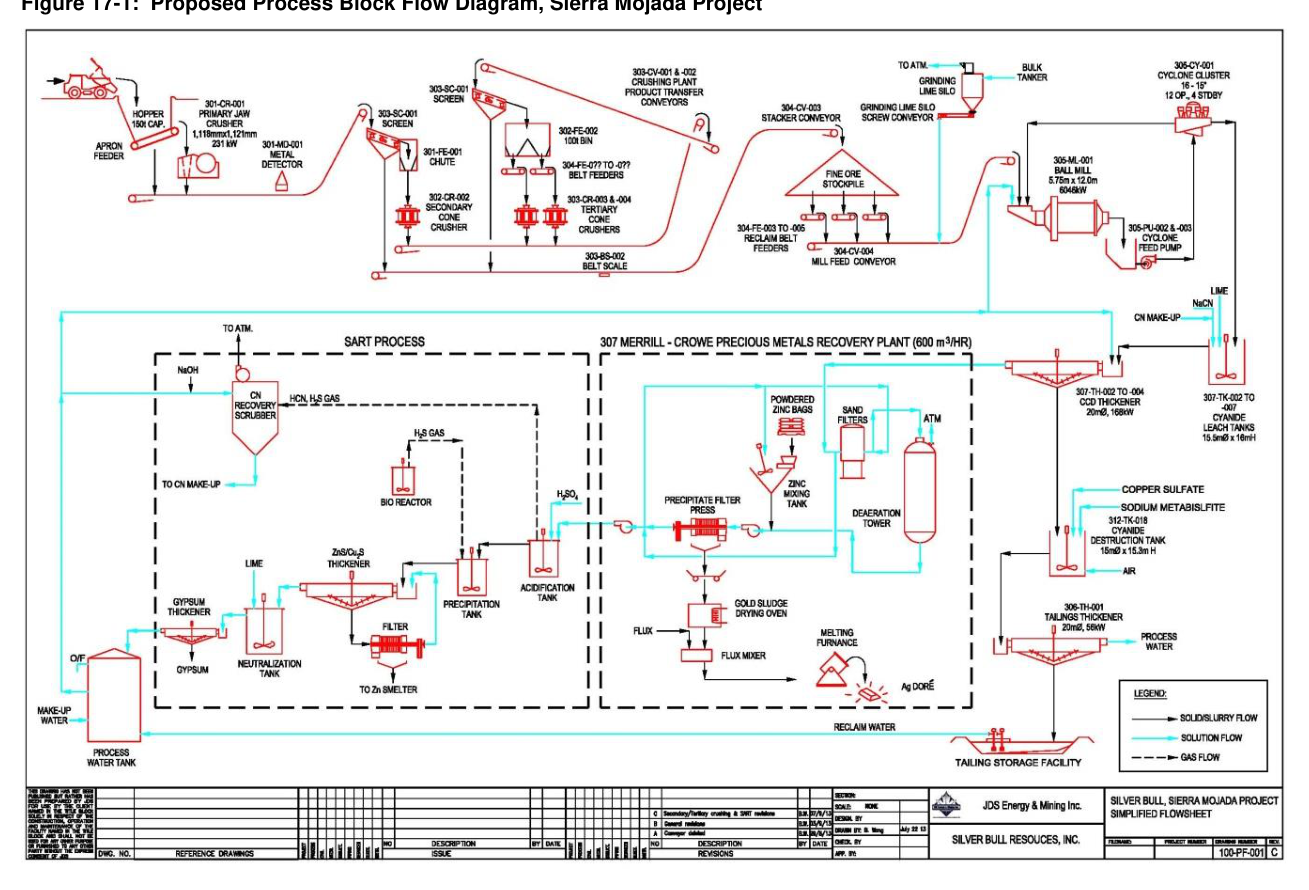
The November 2013 preliminary economic assessment for Silver Bull's Sierra Mojada project in Coahuila, Mexico describes grinding to 53 microns, a 24-hour leach in six tanks, silver precipitation with zinc dust and a SART circuit that makes a zinc sulphide precipitate.
Sierra Mojada is a silver-zinc project in Coahuila, Mexico. Silver Bull Resources, Inc. is the issuer of the NI 43-101 preliminary economic assessment (PEA), which has a report date of November 13, 2013 and an effective date of September 30, 2013. The project will use a single flow sheet and process facility to treat both the silver ores and the zinc ores. The silver ores will use cyanide leach technology, and the zinc ores will be blended into the ore feed to allow zinc recovery in the SART portion of the flow sheet. The report states that the level of process design meets the requirements for a PEA, and that the design draws on the test work results in the report's metallurgy section.
Critical Data
| Parameter | Value | Unit | Notes |
|---|---|---|---|
| Grind size | 53 | µm P80 | To maximize silver recovery |
| Crushing stages | 3 | Not applicable | Jaw, secondary cone, two tertiary cones |
| Grizzly bypass | 5 | in | Finer material bypasses the jaw crusher |
| Fine ore size | Under 0.75 | in | Screen cut for the stockpile |
| Ball mill slurry | 70 | % solids | Closed circuit with hydrocyclones |
| Cyclone overflow | 40 | % solids | 80% passing 53 microns |
| Leach tanks | 6 | Not applicable | Series, 24 hours of leach time |
| Leach pH | 10.5 | pH | Weak cyanide, lime buffered |
| CCD thickeners | 3 | x 20 m | 3:1 wash ratio |
| Tailings thickener | 20 | m | High rate |
| Products | Silver doré and zinc sulphide precipitate | Not applicable | High-grade zinc concentrate |
Overview
The mineral processing and metals recovery plant will be arranged as separate installations in close proximity to each other, not in a single building. After crushing and grinding, a cyanide leach and counter-current decantation (CCD) circuit feeds pregnant solution to a Merrill-Crowe silver recovery plant. Once the silver has been recovered, cyanide recovery and zinc recovery take place in a SART facility. Tailings from the leach circuit are detoxified in a cyanide destruct circuit before going to a tailings storage facility.
Key Process Stages
Crushing and grinding
The first crusher will likely be a jaw type fed by an apron grizzly feeder that lets material finer than 5 inches bypass. Jaw product combines with the grizzly fines and is screened on a secondary deck. Material below 0.75 inch bypasses the secondary and tertiary crushers and goes straight to the fine ore stockpile, while coarser material goes to a secondary cone crusher. Its product goes to a tertiary screen deck, and plus 0.75 inch material feeds one of two tertiary cone crushers, with tertiary product recirculated to the screen. A fine material stockpile with three reclaim belt feeders, a discharge conveyor, and a lime silo with a screw feeder follows. A single primary ball mill slurries the minus 0.75 inch material to 70% solids, in closed circuit with hydrocyclones, giving an overflow of 40% solids with 80% passing 53 microns.
Cyanide leach and CCD
Cyclone product feeds by gravity to six agitated leach tanks in series, with blowers for aeration, allowing 24 hours of leach time. A weak cyanide solution at pH 10.5, buffered with lime, leaches silver and zinc. Flow between tanks is by gravity through internal pipes and launders. Three 20 m high rate CCD thickeners in series use a 3:1 wash ratio. Solids from the third thickener go to cyanide destruction, and the pregnant solution overflowing the first thickener goes to Merrill-Crowe.
Merrill-Crowe
A vacuum deaeration tower removes oxygen from the pregnant solution, which is then filtered through clarifiers. Zinc dust is added to make a silver precipitate, removed in a filter press. Barren solution goes on to the SART circuit.
SART and Bio-SART
In SART, sulphuric acid is added to the zinc-complexed cyanide solution to break the weak-acid dissociable cyanide-zinc bond. A sulphide reagent, hydrogen sulphide, precipitates the zinc as a marketable high-grade concentrate. The barren cyanide solution is re-neutralized with lime, producing a gypsum by-product, and the remaining cyanide is recycled to silver leaching as free cyanide. In the Bio-SART variant, a biologically generated hydrogen sulphide gas from an anaerobic bioreactor replaces chemical sulphide such as NaHS, which lowers reagent cost and halves acid demand for zinc cyanide treatment. The report names BioteQ's BioSulphide technology for this step.
Cyanide destruction and tailings
Leach tailings are detoxified in a cyanide destruct circuit, thickened in a 20 m high rate tailings thickener and pumped to the tailings storage facility.
Additional Interesting Data and Summary
The plant equipment list comprises a crushing and screening plant with a primary jaw crusher, a secondary cone crusher, two tertiary cone crushers and two multi-deck vibrating screens, the fine ore stockpile, a ball mill and hydrocyclone installation, six leach tanks, the CCD circuit, a Merrill-Crowe plant, a Bio-SART plant and reagent facility, a cyanide destruction circuit and the tailings thickener with pumps.
Reagents required include lime, sodium cyanide, sulphuric acid, acetic acid, potassium phosphate, ammonium sulphate, sodium hydroxide, diatomaceous earth as filter media, flocculant, zinc dust, descalent, sulphur and flux. They will be shipped to site by truck or rail, with enough storage for at least three days in most cases, and metered into their process streams from day tanks in most instances.
Water will be reclaimed from the tailings storage facility for reuse in the process, and initial start-up and make-up water will come from wells. Other consumables include grinding balls, crusher liners, ball mill liners, wear steel, cyclone parts, pump parts, conveyor parts and screen decking, kept as stock items in an on-site warehouse. The project would use infrastructure that supports the town of Esmeralda and the adjacent Mina Dolomita, with a new road from town, a new rail spur and new power and water supplies, and the nearest industrial facility is the Peñoles Química del Rey plant at Laguna del Rey.
Key Processes
- Three-stage crushing with a grizzly bypass
- Ball milling to 53 microns in closed circuit with cyclones
- Six-tank weak cyanide leach
- Three-stage counter-current decantation
- Merrill-Crowe silver precipitation
- SART and Bio-SART zinc and cyanide recovery
- Cyanide destruction of leach tailings
Source: Preliminary Economic Assessment NI 43-101 Technical Report, Sierra Mojada Silver-Zinc Project, Coahuila, Mexico, November 13, 2013.
Project website: Sierra Mojada Silver-Zinc Project
