

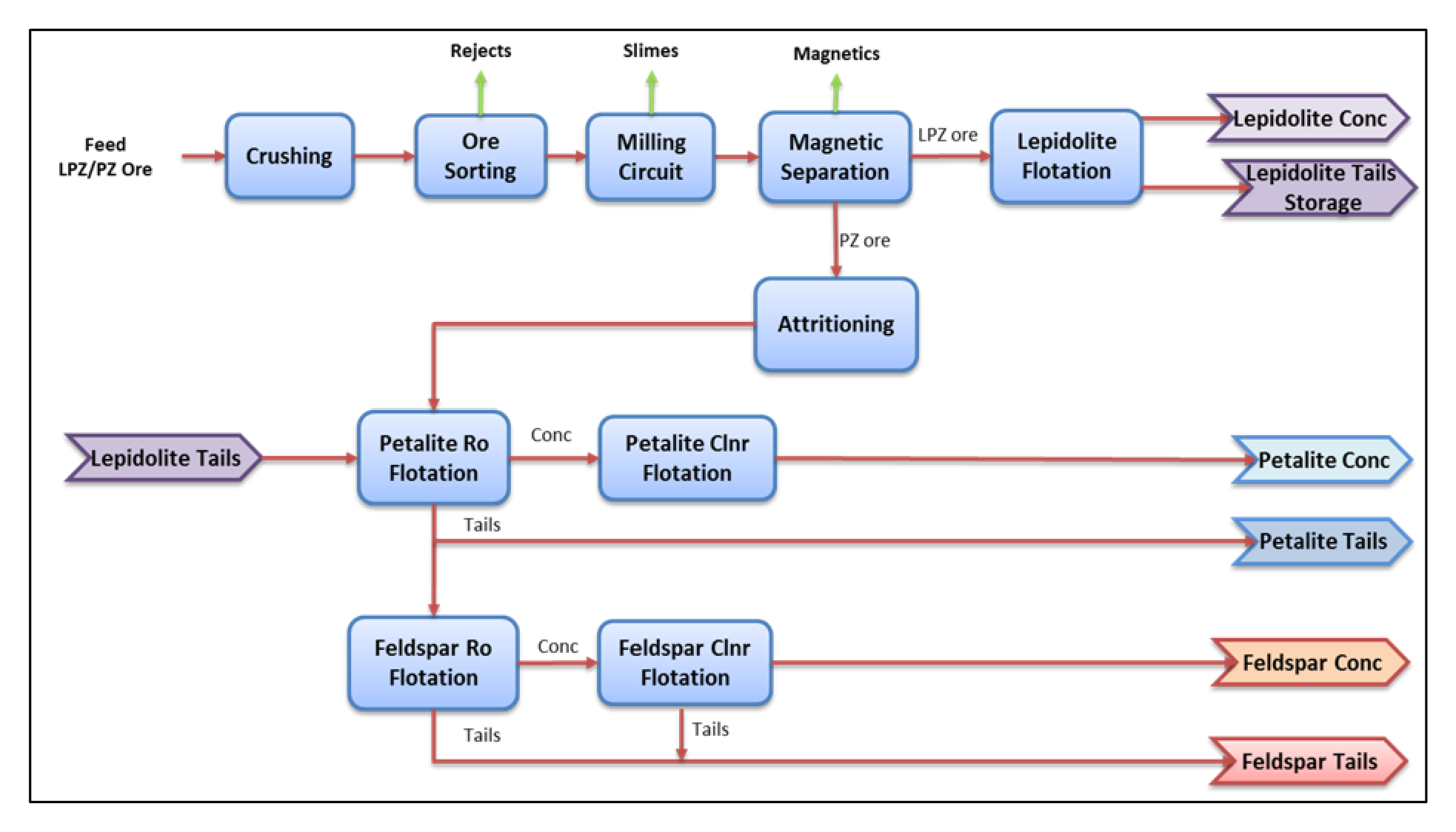
Avalon's September 2018 preliminary economic assessment for the Separation Rapids lithium deposit near Kenora, Ontario stops at flotation concentrates, with optical sorting, magnetic separation, five petalite cleaner stages and a later feldspar circuit, all from a single 200 t/h crushing plant.
The Separation Rapids Lithium Project near Kenora, Ontario is a lithium deposit held by Avalon Advanced Materials Inc. Micon International led the NI 43-101 Technical Report on the Preliminary Economic Assessment for the Production of Petalite Concentrate, with a report date of September 26, 2018 and a PEA effective date of August 21, 2018. The selected process separates a lepidolite concentrate, a petalite concentrate (both containing between 4.0% and 4.50% Li2O) and a mixed sodium and potassium feldspar product. The 2016 PEA converted all petalite to lithium hydroxide, but this study stops at the flotation concentrates, with a hydroxide plant as a later possibility. The mill would treat 475,000 t/y over a 19-year mine life, making about 220,000 t of lepidolite concentrate, 1.32 Mt of petalite and 1.34 Mt of feldspar. The processes were developed and tested by ANZAPLAN in Germany between 2014 and 2018, including 1 t of petalite concentrate from a 2016 pilot program.
Critical Data
| Parameter | Value | Unit | Notes |
|---|---|---|---|
| Annual mill feed | 475,000 | t/y | 19-year mine life |
| Lepidolite concentrate | About 220,000 | t | Life of mine |
| Petalite concentrate | 1.32 | Mt | Life of mine |
| Feldspar concentrate | 1.34 | Mt | Life of mine |
| Concentrate grade | 4.0 to 4.5 | % Li2O | Life of mine average petalite 4.25% |
| Crushing circuit rate | 200 | t/h | One 12-hour shift a day |
| Ball mill feed | 67.4 | t/h | Dry basis |
| Optical sorter waste rejection | 1.8 | % of mass | 1.8% lithium loss |
| Magnetic pull (petalite only) | 13 | % of mass | 13.8% lithium loss |
| Lithium recovery to lepidolite | 78 | % | LPZ mineralization |
| Lithium recovery to petalite from lepidolite tails | 70 | % | Not applicable |
| Lithium recovery to petalite | 65.2 | % | Of flotation feed, PZ mineralization |
| Feldspar mass pull | 82.9 | % | Of feldspar flotation feed |
| Flotation plant availability | 90 | % | Not applicable |
| Feldspar concentrate capacity | 100,000 | t/y | Starts in year 5 |
Overview
The plant processes lepidolite and petalite mineralization (LPZ and PZ) on a campaign basis through one milling and flotation circuit. Tailings from lepidolite flotation are stockpiled for later petalite recovery. Some of the final petalite tailings feed a second, dedicated feldspar circuit and the rest go to the tailings management facility (TMF). The magnetic concentrate, slimes smaller than 20 microns and all final tailings are dewatered and dry stacked in the TMF.
Key Process Stages
Crushing and sorting
Run-of-mine material is trucked to a stockpile, reclaimed by loader and fed to a bin with a 400 mm static grizzly. A vibrating grizzly feeder at 200 t/h sends plus 150 mm oversize to a jaw crusher, and a vibrating screen sends plus 50 mm material to a secondary cone crusher. A second screen splits material into three sizes. Plus 25 mm goes to an optical sorter that rejects waste rock, mainly amphibolite, and non-waste goes to a tertiary cone crusher. The minus 25 plus 8 mm fraction goes to a second sorter, and minus 8 mm goes to a silo holding 24 hours of crusher product. The 1.8% reject rate was measured on a 30 t bulk sample processed in Germany.
Comminution, magnetic separation and desliming
A ball mill runs in closed circuit with fine screens cutting at 150 µm, and screen undersize goes first to a low intensity magnetic separator (LIMS) and then a high intensity (WHIMS) unit that removes weakly magnetic lithium and iron micas. Magnetic products go to a thickener. Non-magnetics are dewatered by cyclones to about 60% solids and scrubbed in attritioners to clean mineral surfaces, then deslimed in cyclones cutting at 20 µm. Slimes join the magnetics to the thickener, and desliming underflow is dewatered on a belt filter. The magnetic separators are bypassed when processing lepidolite.
Petalite flotation
Filter cake is re-pulped in an 8% brine of 50:50 sodium chloride and potassium chloride and pumped to the petalite circuit, where reclaimed lepidolite tailings can also be added. Rougher and rougher-scavenger flotation are followed by five cleaner stages. After cleaner 2, the concentrate is filtered to about 10% moisture on a belt filter to remove excess brine, and re-slurried in fresh process water, because the chemistry and reagents in the last three stages differ. Cleaner 3 tails go to a filter for disposal, cleaner 4 tails return to cleaner 3, and cleaner 5 tails recycle to cleaner 4. Final concentrate is sampled, filtered and dried.
Concentrate handling
Petalite concentrate is washed on a belt filter and dried in a rotary dryer to less than 1% moisture, then packed in 2 t bulk bags for export by a nearby railway siding to customers in Europe and North America. Filtrate returns to the cleaner process water.
Feldspar flotation
The feldspar circuit begins in year 5 and has a rougher and two cleaner stages, designed for 100,000 t/y of concentrate. Re-pulped petalite tailings, about 22 t/h, are conditioned with reagents and floated, with extra reagents before each cleaner. The concentrate is dewatered, washed, dried in a rotary dryer, cooled and bagged. About 40,000 t/y is aimed at paint and fibreglass filler markets, which first need milling to a d50 of 6.3 µm in an air-swept ball mill with ceramic balls and liners and an air classifier.
Additional Interesting Data and Summary
The plant has five tailings circuits. The first thickens and filters comminution slimes and magnetics for dry stacking. The second filters petalite cleaner 3 tailings, the third filters lepidolite or petalite scavenger tails, with about half of the petalite tailings repulped for feldspar, and the fourth repulps reclaimed lepidolite tails for petalite flotation. The fifth handles a small amount of feldspar tails. All circuits are designed for filter cakes averaging about 10% moisture.
Mass and lithium losses in comminution depend on mineralization. For petalite PZ, 7.9% of mill feed goes to slimes with an 8.6% lithium loss, and for lepidolite LPZ the figures are 8.4% and 6.5%. The lepidolite will be sold to the lithium chemicals industry in Canada and Asia, the petalite to glass and ceramics customers in Europe, Asia and North America, and the feldspar to buyers in North America and Europe.
Key Processes
- Multi-stage crushing and optical sorting
- Ball milling with fine screens
- Low and high intensity magnetic separation
- Attrition scrubbing and cyclone desliming
- Brine-based petalite flotation with five cleaner stages
- Lepidolite and feldspar flotation
- Dry stacking of filtered tailings
Source: NI 43-101 Technical Report on the Preliminary Economic Assessment for the Production of Petalite Concentrate from the Separation Rapids Lithium Deposit, Kenora, Ontario, September 26, 2018.
Project website: Separation Rapids Lithium Project
