

WSP's May 2015 preliminary economic assessment for Timberline Resources' Talapoosa gold-silver project in Lyon County sizes a 10,460 t/d heap leach with three crushing stages, a 60-day primary and a 60-day intermediate leach, and a 3,700 gpm solution system.
The Talapoosa Project lies in Lyon County in northwestern Nevada, about 28 miles in a straight line east of Reno. The Preliminary Economic Assessment on the Talapoosa Project, report number 151-02327-00_RPT-02_R3 by WSP for Timberline Resources Corporation, is dated May 2015. The conceptual scheme processes resource material inside the PEA pit shell and is based on results from earlier metallurgical tests. Gold and silver from the Talapoosa deposits will be recovered using industry standard heap leach cyanidation and gold precipitation techniques. Material from the mine is crushed, agglomerated and stacked on a heap, and cyanide solution percolates through it. The study is most sensitive to gold price and gold recovery, and all material types tested were sensitive to feed size, with fine crushing raising gold and silver recovery significantly.
Critical Data
| Parameter | Value | Unit | Notes |
|---|---|---|---|
| Daily production | 10,460 | t/d | 10,450 t/d at 95% operating time in the HPGR diagram |
| Material bulk density | 100 | lb/ft3 | Not applicable |
| Heap lift height | 20 | ft | Stacked agglomerate |
| Primary leach cycle | 60 | days | 0.004 gpm/ft2 |
| Intermediate leach cycle | 60 | days | 0.004 gpm/ft2 |
| Primary area under leach | 925,000 | ft2 | Not applicable |
| Intermediate area under leach | 925,000 | ft2 | Not applicable |
| Solution flow | 3,700 | gpm | Barren to heap |
| HPGR product | Nominal 10 | mesh | 3,000 ton live stockpile |
| Crushed stockpiles | 3 | piles | 3,000 ton live capacity each |
| Stacker | 20 | ft | Radial stacker stinger |
| Make-up water | About 500 | gpm | Water balance is negative |
| Average precipitation | 13.4 | in/y | High desert climate |
| Average evaporation | 50 | in/y | Not applicable |
| Storm design | 25-year, 24-hour | event | 2.0 inches of rain |
Overview
The Talapoosa flowsheet is a heap leach with three stages of crushing, including a high pressure grinding roll (HPGR) that makes a nominal 10 mesh product. The fines from the HPGR circuit are combined with lime and cement in an agglomeration drum, and the agglomerate is stacked on a lined pad. Leach solution goes through two cycles, an intermediate leach on once-leached material and a primary leach on fresh material. Pregnant solution is clarified, de-aerated and treated with zinc in a Merrill-Crowe plant.
Key Process Stages
Crushing
Mineralized material is dumped into a pocket above a vibrating grizzly, with oversize moving over the bars to a large jaw crusher. Jaw product and grizzly undersize share one conveyor to a primary stockpile with 3,000 tons of live capacity. An apron feeder in a steel reclaim tunnel feeds a vibrating secondary screen above a heavy-duty standard cone crusher. Coarse material goes into a day bin above the cone crusher, and crushed product joins the screen fines in a second 3,000 ton live stockpile.
HPGR crushing
A vibrating pan feeder in a reclaim tunnel moves secondary product to a day bin and then to the HPGR. HPGR discharge is screened on twin double-deck screens to remove the fine product. Oversize returns to the day bin to mix with fresh feed. The nominal 10 mesh product is stacked in a third 3,000 ton live stockpile.
Agglomeration and stacking
A vibrating pan feeder moves HPGR product to a weight-indexed belt, where lime and cement are combined with the fines. Water is added to the feed end of the agglomeration drum to wet the mix. A transfer conveyor and mobile grasshopper conveyors carry agglomerate to a radial stacker with a 20 ft stinger, building a 20 ft heap.
Leaching and solution handling
Barren solution, adjusted for pH and cyanide strength, is pumped at 3,700 gpm from a barren pond near the plant to once-leached material for secondary leaching at 0.004 gpm per ft2. That solution is collected in an overliner piping system, runs by gravity to an intermediate solution pond and is pumped back onto fresh material for primary leaching at the same rate. Primary solution goes to the pregnant pond. Both cycles last 60 days. The pregnant and intermediate ponds are double lined with leak detection and can hold an 8-hour heap drain down after a power loss, and the event pond can contain a 25-year, 24-hour storm along with an 8-hour outage. The storm pond is single lined.
Merrill-Crowe plant
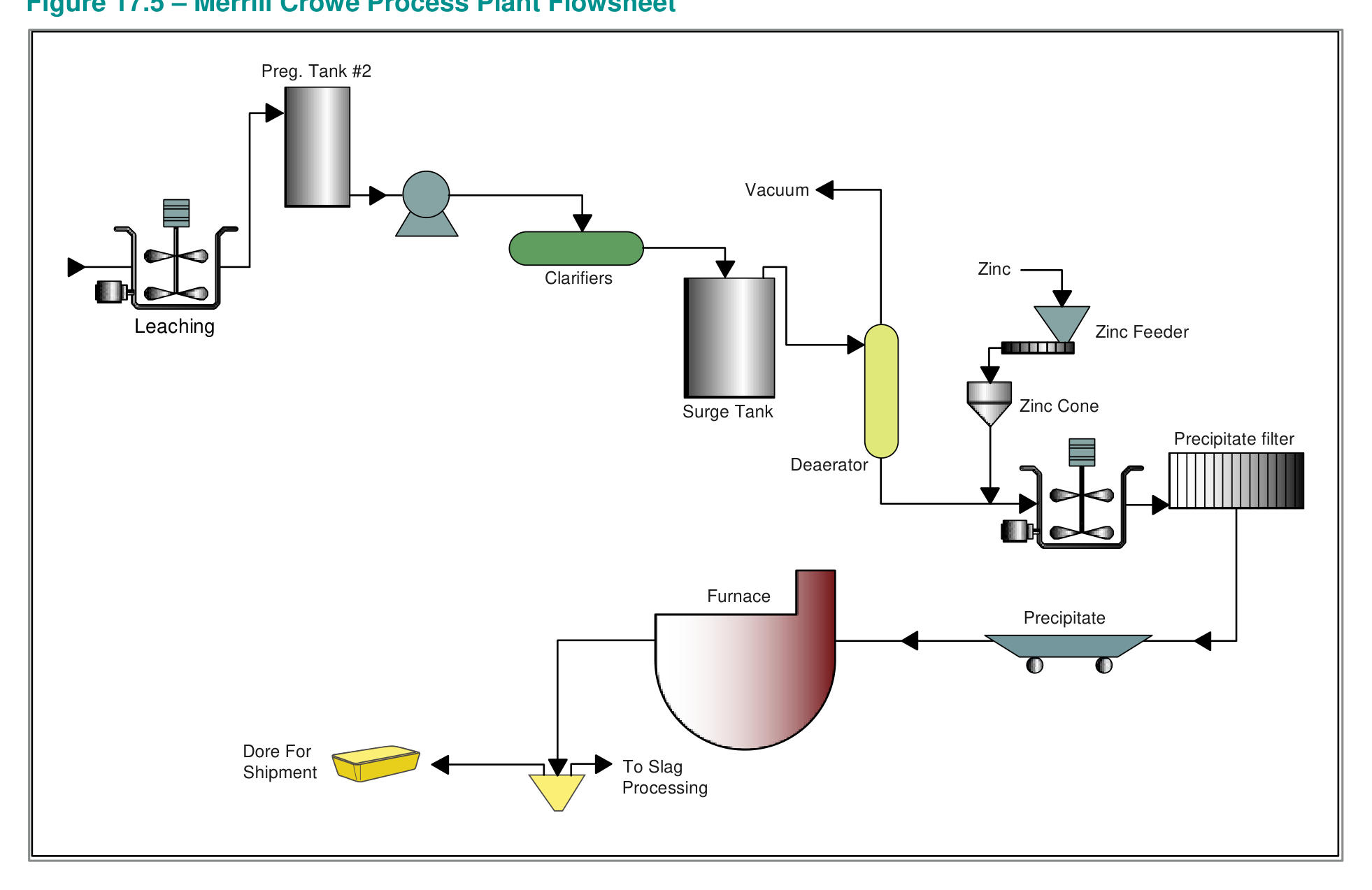
Pregnant solution is pumped to plate and frame clarifying filters, de-aerated by vacuum, combined with zinc powder and sometimes lead nitrate, then pumped to plate and frame precipitation filters. Diatomaceous earth coats the precipitate filter to catch fine gold and silver. Precipitate goes to a mercury retort where vapour is volatilized and collected through chilled decantation. Mercury-free precipitate is melted with fluxes in crucibles, the slag is poured off and cooled into glass, and doré is poured into bars or buttons, stamped, photographed and vaulted before shipment to a master refiner. There is no discharge of process solutions, since barren solution is adjusted and recirculated to the heap.
Additional Interesting Data and Summary
Water is a net requirement, because evaporation of 50 inches a year far exceeds 13.4 inches of precipitation, and snowfall can account for up to one-third of annual precipitation. The water balance sets make-up water at about 500 gpm for roughly 2,000,000 ft2 of material under leach. After large storms, water in the ponds is used as make-up and well water is cut back. Design storm rainfall for the 10, 25 and 100-year 24-hour events is 1.6, 2.0 and 2.4 inches.
For detoxification, the report relies on natural degradation of residual cyanide in the heap and solutions, through volatilization, hydrolysis in soils, microbial and anaerobic degradation and complexation. It adds that more stringent chemical detoxification might be applied before closure. Intermittent circulation of solution continues while Merrill-Crowe operations are suspended. Aeration and agricultural chemicals could promote microbial growth.
Key Processes
- Jaw crushing and secondary cone crushing
- HPGR fine crushing to a nominal 10 mesh product
- Lime and cement agglomeration
- Radial stacker heap construction at 20 ft
- Two-cycle cyanide heap leaching
- Merrill-Crowe zinc precipitation with mercury retorting
- Natural cyanide degradation
Source: Preliminary Economic Assessment on the Talapoosa Project, Nevada, May 2015.
