

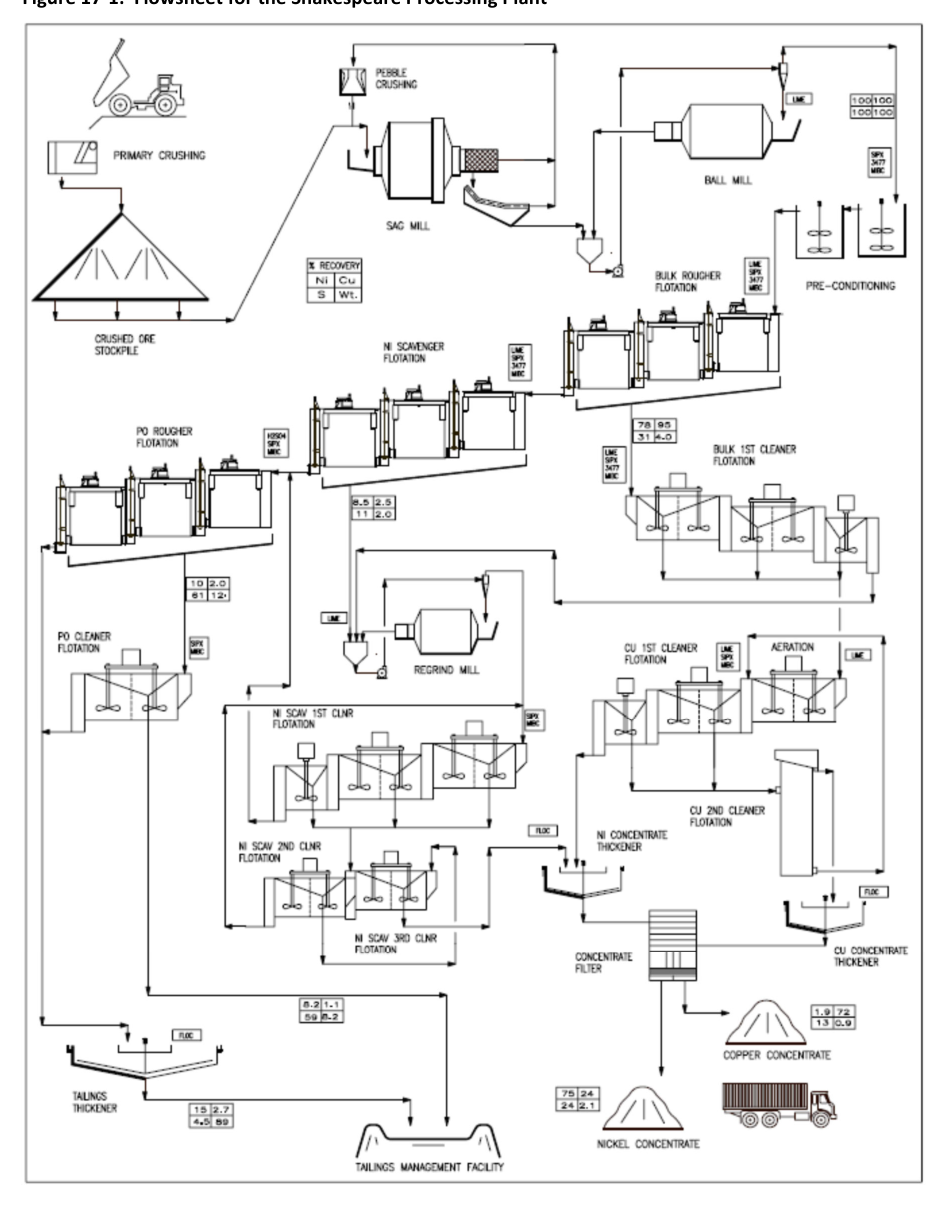
Magna Mining's January 2022 feasibility study for the Shakespeare project near Espanola, Ontario describes jaw crushing, a SAG and ball mill circuit, a six-cell bulk and nickel scavenger rougher, a copper column cleaner and a pyrrhotite circuit, with toll smelting of both concentrates.
The Shakespeare Project is a past-producing nickel-copper deposit in Shakespeare Township, near Espanola, Ontario, and is the development focus of Magna Mining Inc., a Toronto-based company listed on the TSX. AGP Mining Consultants prepared the Feasibility Study Technical Report, with an effective date of January 2022. The concentrator is designed for a nominal 135,000 t/month of run-of-mine feed, or 4,500 t/d. The flowsheet, developed from laboratory testwork, consists of primary jaw crushing, SAG/ball mill grinding, froth flotation, concentrate dewatering, and tailings thickening. The copper and nickel concentrates are filtered and trucked off site in bulk for toll smelting. Design head grades are 0.33% nickel, 0.36% copper and 4.0% sulphur.
Critical Data
| Parameter | Value | Unit | Notes |
|---|---|---|---|
| Plant throughput | 4,500 | t/d | 135,000 t/month |
| Crushing availability | 70 | % | Primary crusher designed for 72% |
| Grind and flotation availability | 92 | % | 24/7 operation |
| SAG mill | 24 ft x 10 ft | Not applicable | 2,650 kW variable speed |
| Ball mill | 15 ft x 25 ft | Not applicable | 2,650 kW single pinion |
| Ball mill product | 85 | µm P80 | Three 660 mm cyclones |
| Bulk rougher time | 15 | min | Three 50 m3 cells |
| Nickel scavenger time | 18 | min | Three 50 m3 cells |
| Nickel scavenger regrind | 50 | µm | 6.5 ft x 10 ft, 100 kW mill |
| Nickel in nickel concentrate | 74.7 | % recovery | 13.3% Ni grade, 2.8% mass |
| Copper in copper concentrate | 60.0 | % recovery | 30.0% Cu grade, 0.7% mass |
| Copper to nickel concentrate | 35.1 | % | Not applicable |
| Pyrrhotite tailings | 3.7 | % of mass | 35.0% sulphur |
| Fresh water use | 0.60 | m3/t | Not applicable |
| Power consumption | 36.6 | kW/t | Process plant |
Overview
Mine trucks tip into a surge bin feeding a jaw crusher, and a covered stockpile holds 24 hours of live capacity. A SAG mill with a pebble crusher and a ball mill grind to 85 µm. Cyclone overflow is conditioned with lime and collectors and goes to a six-cell rougher-scavenger bank. The first three cells float a bulk sulphide concentrate, and the last three recover a nickel scavenger concentrate. The bulk concentrate is split into copper and nickel products, and a pyrrhotite circuit sends the sulphur-rich tailings to the CDA.
Key Process Stages
Crushing
Ore is delivered by 90 t haul trucks at an average of three to four trucks an hour, with a peak of 360 t/h, into a rail-lined 135 t surge bin. A vibrating grizzly feeder passes plus 70 mm oversize to a 36 in by 48 in jaw crusher with a 100 mm closed side setting, which takes a top size of 700 mm. Crushed ore moves by sacrificial conveyor to the covered stockpile, and a dust collection system serves the crusher and transfer point.
Grinding
Two reciprocating feeders, one standby, move ore from the reclaim tunnel to the SAG mill, a 24 ft by 10 ft grate discharge mill with a 2,650 kW variable speed drive. Trommel oversize pebbles return by conveyor, and undersize goes to a 6 ft by 12 ft classification screen with 2 mm openings. Screen underflow feeds a cyclone cluster of three 660 mm cyclones, two operating, with an 85 µm cut. Underflow goes to a 15 ft by 25 ft overflow ball mill with a 2,650 kW drive, and its discharge trommel has 10 mm openings. Cyclone overflow passes a linear trash screen to remove woodchips and plastic before flotation.
Bulk and copper flotation
Two conditioning tanks add lime for pH, with SIPX and Aero 3477 as collectors. The bulk rougher is three 50 m3 tank cells, and its concentrate goes to a bulk first cleaner of five 4.3 m3 trough cells. The first two cleaner cells collect no concentrate, since they act as an aeration and conditioning step before copper and nickel sulphides separate. Concentrate from the last three cells goes to a copper second cleaner, a single flotation column 1.5 m in diameter and 5.7 m tall with a fine bubble sparger and wash water. Its concentrate is the final copper product, and copper first cleaner tailings, rich in nickel sulphides, form most of the nickel concentrate.
Nickel scavenger flotation
Bulk rougher tailings feed the nickel scavenger, three 50 m3 cells. Its concentrate joins the bulk first cleaner tailings at the regrind cyclone cluster of two 254 mm cyclones. Underflow goes to the regrind mill, and overflow passes through three stages of cleaning, with five, two and two 4.3 m3 trough cells. Third cleaner concentrate combines with the copper first cleaner tailings as the final nickel concentrate.
Pyrrhotite flotation
Nickel scavenger tailings and first cleaner tailings feed a pyrrhotite rougher of three 50 m3 cells. Its concentrate gets one cleaning stage in two trough cells, and the cleaner concentrate is pumped to the CDA for disposal. Non-pyrrhotite tailings are thickened and pumped to the tailings management facility.
Concentrate dewatering
Copper concentrate goes through an automatic sampler to a 6 m high-rate thickener, then to an agitated storage tank and a common copper and nickel pressure filter. Filtrate returns to the thickener feed box, and cloth is washed at high pressure after each cycle. Cake falls onto a bi-directional conveyor and a stockpile, and a front-end loader loads trucks to a toll smelter. Trucks are weighed and auger-sampled at the weighbridge. Nickel concentrate goes through a similar sampler and a 6 m thickener ahead of the same filter.
Additional Interesting Data and Summary
Frother, collector and lime are mixed in a central reagent area and fed to flotation by peristaltic pumps for accurate dosing. Spillage is collected in sumps at the rougher, SAG and ball mill areas and returned to the process. The milling area has an overhead crane and a relining machine, and ball bunkers with magnets and loading chutes feed grinding media to the SAG and ball mills.
The design splits the feed into three streams: a nickel concentrate at 2.8% of mass, a copper concentrate at 0.7%, and tailings, of which 3.7% is pyrrhotite tailings and 89.1% is non-pyrrhotite tailings with less than 0.1% sulphur. Of the nickel contained in the feed, the nickel concentrate takes 74.7%, and the report credits the nickel concentrate with 35.1% of the copper.
Key Processes
- Primary jaw crushing
- SAG and ball mill grinding in closed circuit with cyclones
- Bulk rougher and nickel scavenger flotation
- Copper cleaning in a flotation column
- Three-stage nickel scavenger cleaning with regrind
- Pyrrhotite rejection by flotation
- Thickening and pressure filtration of concentrates
Source: Shakespeare Project Feasibility Study Technical Report, Shakespeare Township, Ontario, Canada, January 2022.
Project website: Shakespeare Project
