

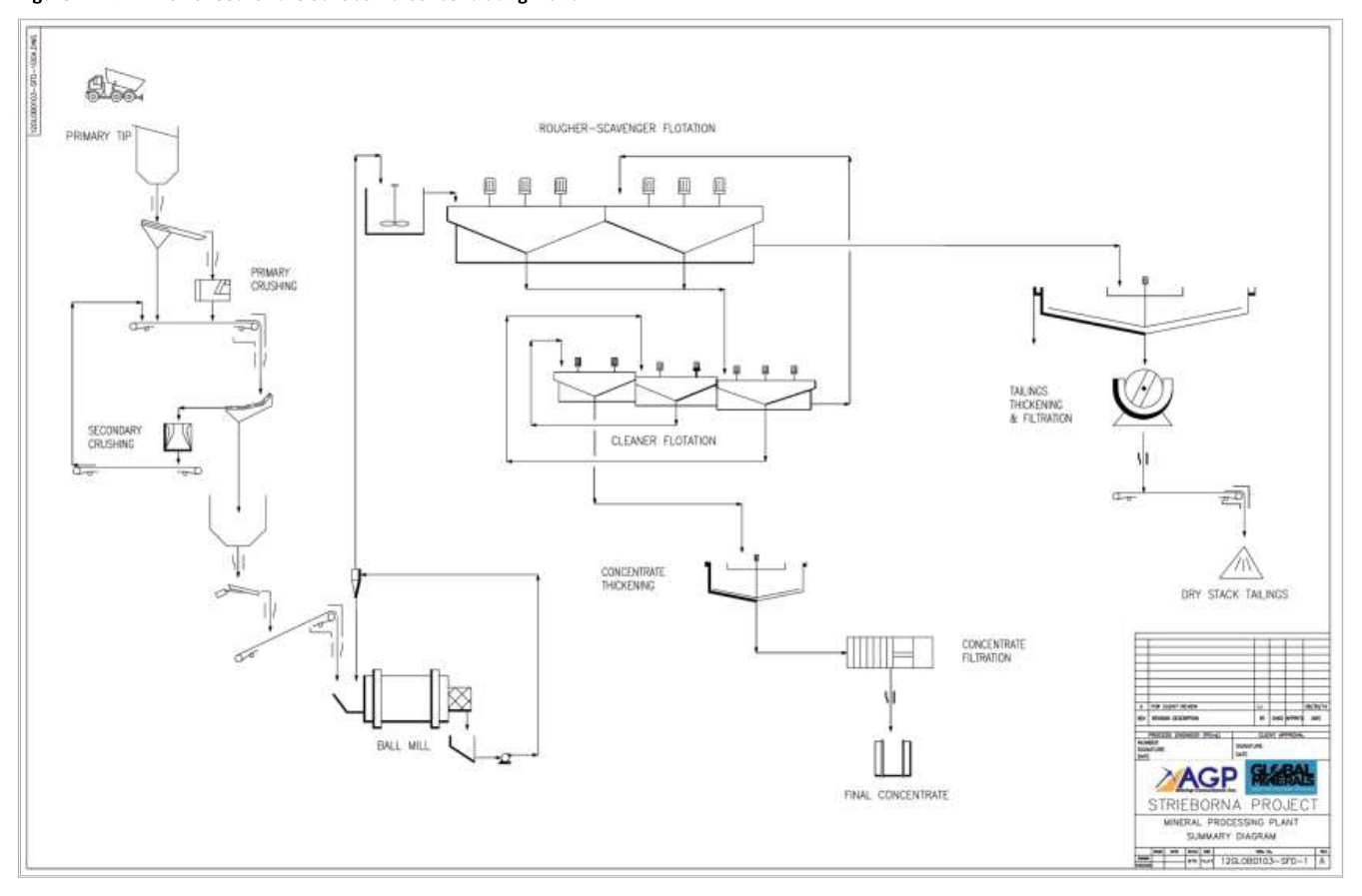
The January 2015 preliminary economic assessment for the Strieborná project in eastern Slovakia designs a small concentrator with eight rougher-scavenger cells and three cleaner stages, and relies on an off-site roaster to remove mercury and antimony before smelting.
The Strieborná Project is a silver-copper-antimony deposit near the town of Rožňava in the Gemer region of eastern Slovakia, held by Global Minerals Ltd. The NI 43-101 Technical Report on the Preliminary Economic Assessment has a report date of January 26, 2015. Mine Development Associates provided the independent resource estimate, and AGP Mining Consultants developed the processing flowsheet and PEA. The proposed method of recovering silver and copper consists of crushing, grinding, flotation and dewatering to produce a flotation concentrate for intermediate treatment at an off-site roaster and subsequent smelting of the calcine. The concentrator would treat 500 t/d, just west of the old Mária Mine tailing storage facility, after averaging 300 t/d in the first 24 months. Life-of-mine head grade is 307 g/t silver, 1.34% copper and 0.92% antimony.
Critical Data
| Parameter | Value | Unit | Notes |
|---|---|---|---|
| Plant capacity | 500 | t/d | 15,000 t/month nominal |
| Initial throughput | 300 | t/d | First 24 months |
| Life-of-mine head grade | 307 g/t Ag | Not applicable | 1.34% Cu, 0.92% Sb |
| Bond ball work index | 8.7 | kWh/t | Not applicable |
| Crushing availability | 86 | % | Seven days a week |
| Grinding and flotation availability | 92 | % | 24/7 operation |
| Jaw crusher closed side setting | 50 | mm | 510 x 800 mm |
| Cone crusher closed side setting | 13 | mm | 100 hp |
| Ball mill | 2.13 m x 3 m | Not applicable | 275 kW |
| Cyclone overflow | About 130 | µm P80 | Two 381 mm cyclones |
| Cleaner concentrate | 4.6 | % of mass | 27.8% Cu, 22.6% S, 6,570 g/t Ag |
| Copper recovery | 98.1 | % | Silver 98.6% |
| Recovery used in PEA | 98.0 | % | Rounded down |
| Concentrate filter cake | 9 | % moisture | Horizontal pressure filter |
| Tailings filter cake | 18 | % moisture | Continuous belt filter |
| Mercury removal in roasting | 99.6 | % | 650 °C for 170 minutes |
Overview
AGP built the PEA flowsheet from 2012 to 2014 testwork. Ore is crushed in two stages, ground in a ball mill, floated in a rougher and scavenger bank with three stages of cleaning, and dewatered. Rougher and scavenger tailings are thickened and belt-filtered for dry stacking. A relatively simple circuit of rougher flotation with three cleaning stages and no regrind was judged sufficient by AGP, based on Blue Coast Research testwork, to make a concentrate at 27.8% copper. Because the concentrate carries high mercury and antimony, an off-site roasting step is part of the strategy.
Key Process Stages
Crushing
Trucks of 20 t deliver feed at one to two trucks an hour, with a peak of 40 t/h, into a rail-lined 30 t surge bin. A vibrating grizzly feeder sends plus 60 mm oversize to a 510 by 800 mm jaw crusher, with grizzly undersize going straight to the screen feed conveyor. A magnet removes tramp metal ahead of the secondary crusher. A 1.2 m by 2.4 m screen with 15 mm slots, inclined at 5°, closes the circuit around a 100 hp cone crusher with a 13 mm closed side setting, which returns to the screen on a recycle conveyor. A dust collection system serves the screen and secondary crusher.
Ball milling
Crushed product goes to a 125 t fine ore bin with about six hours of capacity, and an overflow chute feeds a stockpile with six hours more. A weightometer on the mill feed conveyor controls the feed rate. The ball mill is 2.13 m in diameter and 3 m long, with an overflow discharge and a 275 kW single pinion drive. Its trommel has 13 mm openings, and cyclone underflow returns to the mill. Cyclone overflow passes an automatic sampling station, and grinding media arrives in 200 L drums.
Flotation
Cyclone overflow reports to the rougher feed box. The rougher-scavenger plant has eight trough cells in series, with residence times of 8 minutes for the rougher and 12.5 minutes for the scavenger. Combined concentrate is pumped to three stages of cleaning of 15, 12 and 9 minutes, with tails from each stage returning to the previous stage. Cleaner tailings go back to the head of the scavenger bank. The third cleaner concentrate is the plant's final product. Frother, collector and lime are mixed in a central reagent area and dosed by peristaltic pumps.
Dewatering
The final concentrate goes to a 3 m high-rate thickener sized at 3.4 t/d/m2 and then to a horizontal pressure filter that cuts moisture to 9%. Rougher-scavenger tailings go to an 8 m high-rate thickener at 10.3 t/d/m2 and a continuous belt filter, which delivers cake at about 18% moisture for dry stacking.
Roasting and deleterious elements
The concentrate carries significant mercury and antimony. They attract smelter penalties, and high mercury can make the product unsaleable. Roasting tests removed 99.6% of mercury at 650 °C for 170 minutes in a nitrogen atmosphere, leaving 30 ppm in the calcine, and up to 37.4% of antimony at 950 °C. An alkali leach with sodium hydroxide and sodium sulphide at 95 °C was also tested, extracting 97% of antimony and 92% of mercury.
Additional Interesting Data and Summary
Table 17-1 gives the life-of-mine metallurgical projection for a feed with 1.30% copper, 0.99% sulphur and 307 g/t silver. The cleaner concentrate holds 98.1% of copper, 95.6% of sulphur and 98.6% of silver. Cleaner tailings are 0.9% of mass and rougher tailings 95.0% at 0.02% copper and 3.5 g/t silver. Locked-cycle tests showed good metallurgical stability, which AGP read as a sign that the flowsheet is robust.
The design criteria use limited testwork and the report calls them preliminary. The mill design takes 750 dmt/d as a capacity basis, 29.1 dry tonnes per hour in the crusher circuit and 22.6 in the mill circuit. The ball mill needs 8 kWh/t at the pinion, with 199 kW consumed and 275 kW recommended.
Key Processes
- Two-stage jaw and cone crushing
- Ball mill grinding with cyclones
- Rougher-scavenger flotation with three cleaning stages
- Concentrate thickening and pressure filtration
- Tailings thickening and belt filtration for dry stacking
- Off-site roasting for mercury and antimony removal
Source: NI 43-101 Technical Report, Preliminary Economic Assessment for the Strieborná Project, Eastern Slovakia, January 26, 2015.
