

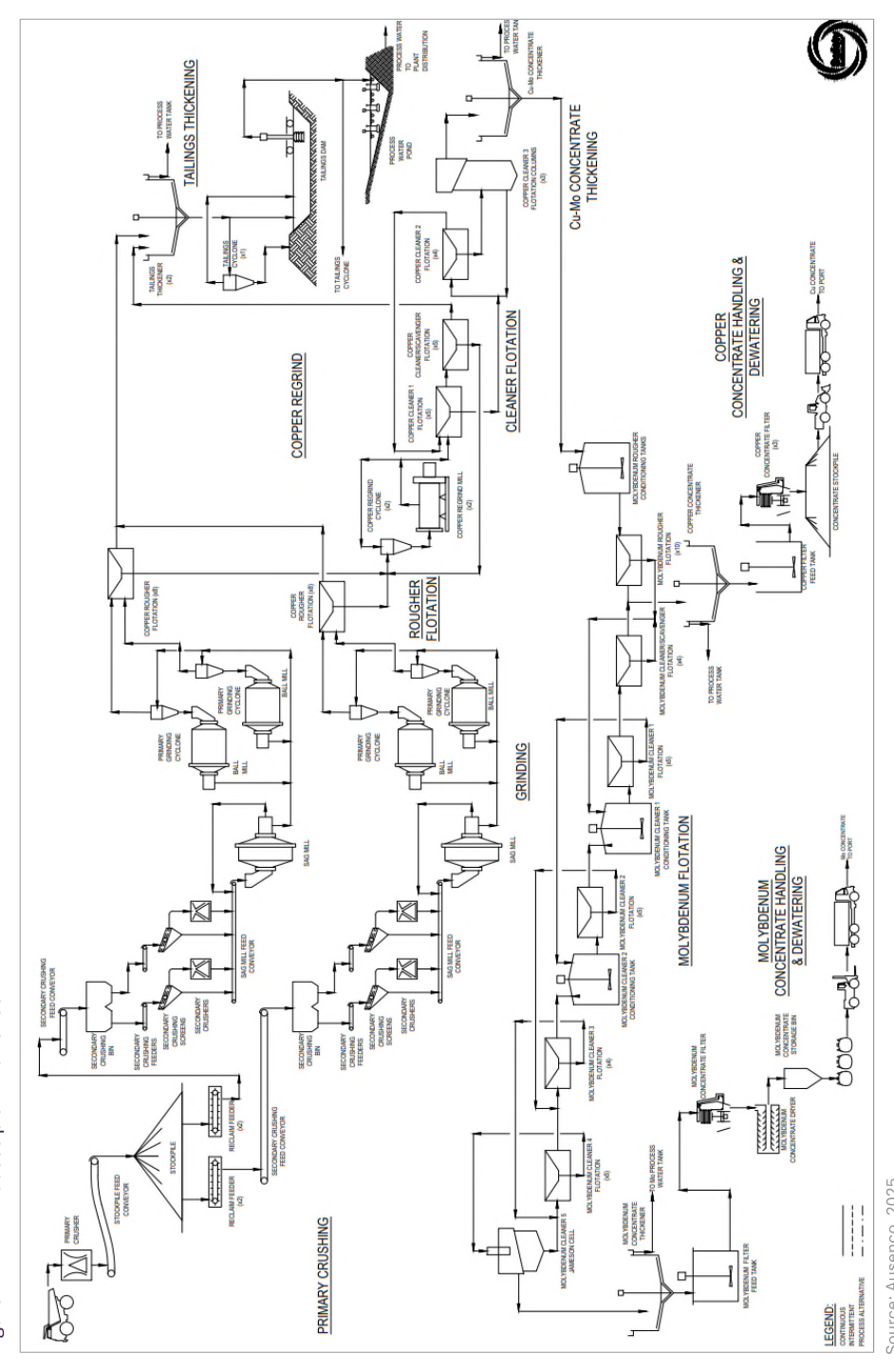
The November 2025 pre-feasibility study for Solaris Resources' Warintza project in Ecuador describes a 22-year open pit, two 12.19 m SAG mills, four ball mills, sixteen 630 m3 rougher cells, five-stage molybdenum cleaning and cyclone-built tailings walls.
Warintza is a copper-molybdenum porphyry project in Morona Santiago, Ecuador. AMC Mining Consultants prepared the Technical Report, Pre-Feasibility Study and Updated Mineral Resource Estimate for Solaris Resources Inc., with an effective date of 1 November 2025 and a report date of 10 November 2025. The process plant is designed to treat 165,000 tonnes per day, approximately 60.2 Mt a year, of ore to make separate copper and molybdenum concentrates over a 22-year open pit mine life. The operating basis for design is 6,570 h/y for primary crushing, 8,000 h/y for secondary crushing, grinding and flotation, 7,200 h/y for the concentrate filters and 6,000 h/y for tailings classification by cyclones.
Critical Data
| Parameter | Value | Unit | Notes |
|---|---|---|---|
| Throughput | 165,000 | t/d | 60,225,000 t/y |
| Average life-of-mine grades | 0.31 / 163 / 0.043 | % Cu / ppm Mo / g/t Au | Maximum 0.51 / 304 / 0.061 |
| Copper recovery | 84.2 / 88.6 | % | Life of mine average / design |
| Molybdenum recovery | 71.9 | % | Life of mine average |
| Gold recovery | 60.4 | % | Life of mine average |
| Drop weight Axb | 32.2 | Not applicable | Years 1 to 5 average |
| Bond ball mill work index | 14.7 | kWh/t | 75th percentile |
| Primary crusher | 1,800 x 3,300 | mm | Gyratory, 1,500 kW, P80 97 mm |
| Secondary crushers | 4 | MP1000 or equivalent | 746 kW each, P80 50 mm |
| SAG mills | 2 | 12.19 m x 7.62 m EGL | 24,000 kW each, dual pinion |
| Ball mills | 4 | 8.53 m x 14.63 m EGL | 22,000 kW each |
| Grind size | 150 | µm P80 | Four 16-unit cyclone clusters |
| Copper regrind | 25 | µm P80 | IsaMill M20,000, 5,500 kW |
| Copper rougher cells | 16 | x 630 m3 | Forced air mechanical |
| Copper concentrate grade | 26.5 | % Cu | 2.6 g/t Au, 10% moisture |
| Bulk Cu-Mo concentrate | 25.8 | % Cu | Elevated 36 m thickener |
| Molybdenum concentrate | 40.0 | % Mo | 1.5% Cu, 15% moisture before drying to 5% |
| Tailings thickeners | 2 | x 85 m | 55% w/w underflow |
| Tailings cyclone sand | 25,000 | t/d | 43% mass split, for TMF wall construction |
Overview
The process plant includes primary crushing, crushed ore stockpiling and reclaim, secondary screening and crushing, SAG mill and ball mill (SAB) grinding with pebble recycle, copper flotation with rougher flotation, concentrate regrind, three-stage cleaning and a cleaner-scavenger, bulk copper-molybdenum concentrate thickening, and molybdenum flotation. Copper and molybdenum concentrates are thickened and filtered, with molybdenum dried and bagged. Tailings are thickened, pumped and classified by cyclones to produce sand for tailings management facility (TMF) wall construction, with water recovery and services around the plant. Services include lime slaking, flotation reagents and flocculants, grinding media addition, raw, fire, gland, cooling, process and potable water, high pressure and low pressure air, and a nitrogen plant and carbon dioxide storage.
Key Process Stages
Crushing and grinding
A top-service gyratory crusher of 1,800 mm by 3,300 mm with 1,500 kW feeds the crushed ore stockpile, and four double deck banana secondary screens, 3.6 m wide by 7.3 m long, work with four MP1000 cone crushers. Grinding uses two grate discharge SAG mills with trommel screens, 12.19 m in diameter by 7.62 m EGL, each with 24,000 kW dual pinion drives, and SAG discharge screens, followed by four overflow ball mills of 8.53 m by 14.63 m and 22,000 kW with four 16-unit clusters of 33 inch cyclones. Pebbles are recycled.
Copper flotation
Sixteen 630 m3 forced air mechanical rougher cells recover copper. Rougher concentrate is reground in an IsaMill M20,000 of 5,500 kW with a 22-unit cluster of 10 inch cyclones to 25 µm P80. First cleaning uses five 160 m3 cells, a cleaner-scavenger uses five 160 m3 cells, second cleaning uses four 160 m3 cells, and third cleaning uses three column cells 6 m in diameter by 14 m high. The bulk copper-molybdenum concentrate is thickened in a 36 m elevated thickener.
Molybdenum flotation
Molybdenum roughing uses ten 42.5 m3 self-aerated cells. Five cleaner stages follow: five 28.3 m3 cells, a cleaner-scavenger of four, second cleaning with five, third cleaning with four, a fourth cleaner of five 14.2 m3 cells, and a Jameson cell for the fifth cleaner. The molybdenum concentrate is thickened in an 8 m thickener, filtered in a Larox PF M12 vertical filter with 8 plates, dried in a Holoflite dryer to 5% moisture and bagged.
Concentrate dewatering and tailings
Copper concentrate is thickened in a 36 m elevated thickener at 0.20 t/h per square metre and filtered in three Larox PF M60 vertical filters with 24 plates at a specific filtration rate of 509 kg per square metre per hour, with seven days of storage. Tailings go to two buried thickeners of 85 m, at 0.75 t/h per square metre and 55% w/w underflow, and are pumped and classified by cyclone clusters of 16 units of 20 inch cyclones at each dam. The cyclone underflow, 70% w/w and with 20% passing 75 µm, makes sand for TMF wall construction.
Additional Interesting Data and Summary
Drop weight tests give an Axb of 32.2 on average and 29.7 at the 75th percentile for years 1 to 5, and 24.7 at the 75th percentile from year 6 to the end of the mine life, so the ore becomes harder over time. The Bond abrasion index is 0.33 g. Projected plant tonnages and recoveries over the life of mine are in the report's economics section.
Key Processes
- Gyratory crushing and cone crushing
- SAG and ball mill grinding with pebble recycle
- Copper rougher flotation, IsaMill regrind and three-stage cleaning
- Molybdenum flotation with five cleaning stages
- Thickening and vertical filtration of concentrates
- Molybdenum drying and bagging
- Tailings thickening and cyclone sand production for dam walls
Source: Technical Report, Warintza Project, Pre-Feasibility Study and Updated Mineral Resource Estimate, November 10, 2025.
Project website: Warintza Project
