

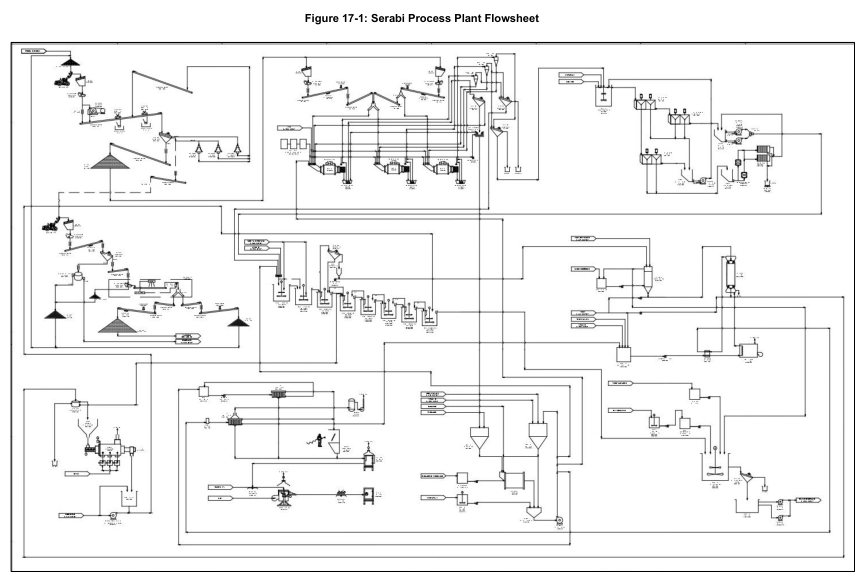
Serabi Gold's Palito Complex in Pará State, Brazil, uses a multi-stage recovery flowsheet that combines ore sorting, copper flotation, gravity concentration, and CIP cyanidation to process gold ore from two underground mines.
The Palito Complex is an operating gold mining operation located in the Tapajós Mineral Province in the western part of Pará State in central north Brazil, near the eastern municipal boundary with the Novo Progresso Municipality. The complex consists of the Palito and São Chico gold deposits and forms part of the Jardim do Ouro property, a group of 26 claims totalling 64,707 hectares in the Tapajós valley. Serabi Gold plc, a United Kingdom registered gold mining and development company based in London, owns the complex through its wholly owned subsidiaries Serabi Mineração S.A. and Gold Aura do Brasil Mineração Ltda. Serabi initially acquired surface rights to the immediate Palito Mine area through a purchase agreement with artisanal miners in 2002 and has since acquired additional parcels of land. Ore mining at the Palito Mine is scheduled to continue until 2034, while mining at São Chico ends in 2030. The processing facilities have been operating continuously, with the recovery methods described in the 2025 Technical Report still valid for this update.
Critical Data
| Parameter | Value | Unit | Notes |
|---|---|---|---|
| Plant capacity | 500 | t/d | Processing ore from both Palito and São Chico mines |
| Crushing feed rate | 35 | t/h | Average feed rate using front-end wheel loader |
| Primary crusher product | 60 | mm | Nominal size after jaw crusher |
| Screen top deck | 38 | mm | Double-deck vibrating screen |
| Screen bottom deck | 15 | mm | Double-deck vibrating screen |
| Ore sorter feed silo | 20 | t | Capacity |
| Ore sorter washing screen aperture | 8 | mm | Vibrating washing screen panels |
| Dewatering screen aperture | 1 | mm | Screen-cloth aperture |
| Fine ore bins | 100 | t | Separate bins for Palito and São Chico ore |
| Grinding product size | 80% passing 120 | µm | All three grinding circuits |
| Hydrocyclone diameter | 250 | mm | Grinding circuits 1 and 2 |
| Intensive leach batch size | 800 | kg | Gekko In-line Leach Reactor (ILR150) |
| Intensive leach duration | 24 | h | Per batch |
| NaCN concentration in intensive leach | 1.5 | % | Maintained solution concentration |
| Hydrogen peroxide addition | 200 | L | Per batch in intensive leach |
| Flotation cell capacity | 3.2 | m³ | Two duplex cells |
| Flotation retention time | 10–12 | min | Rougher-scavenger circuit |
| Flotation pH | 10–11 | , | Lime added in grinding circuit |
| Copper concentrate grade | >20 | % Cu | Cleaner flotation product |
| Gold recovery to copper concentrate | 50–70 | % | Of gold contained in Palito ore |
| Filter press capacity | 300 | kg/hr | Two Andritz filter presses |
| Concentrate moisture | 9 | % | Typical |
| Concentrate packaging | 1 | t wet | Big bags |
| Concentrate shipping lots | 20 | t | Shipped offsite for refining |
| Leach tank volume | 185 | m³ | Two mechanically agitated tanks |
| Adsorption tank volume | 74 | m³ | Six mechanically agitated tanks |
| CIP retention time | 18 | h | Total |
| CIP slurry density | 35 | % solids | Maintained in circuit |
| NaCN in leach tanks | 250 | ppm | Maintained concentration |
| NaCN at adsorption discharge | 100 | ppm | Attenuated concentration |
| CIP pH | 10.5–11.0 | , | Maintained with lime |
| Carbon concentration in tanks 2–6 | 20 | g/L | Adsorption tanks |
| Carbon concentration in tank 1 | 40 | g/L | First adsorption tank |
| Loaded carbon removal frequency | 24 | h | From adsorption tank 1 |
| Elution column capacity | 1.5 | t | Nominal |
| Elution temperature | 130 | °C | Zadra process strip solution |
| Strip solution composition | 2% caustic, 1% cyanide | , | Heated and pumped through column |
| Elution cycle duration | 15 | h | Typical per cycle |
| Carbon regeneration temperature | 750 | °C | Kiln heating |
| Cyanide detoxification residence time | 1.5 | h | Nominal in destruction tank |
| Cyanide discharge level | <5 | ppm CNWAD | After INCO air/SO2 process |
| Tailings feed rate | Not stated | , | Slurry from last CIP tank |
| Sodium cyanide consumption | 1.100 | kg/t | 2025 value |
| Grinding media consumption | 1.282 | kg/t | 2025 value, steel balls |
| Lime consumption | 1.947 | kg/t | 2025 value |
| Collector consumption | 0.059 | kg/t | 2025 value |
| Frother consumption | 0.029 | kg/t | 2025 value |
| Sodium hydroxide consumption | 0.096 | kg/t | 2025 value |
| Hydrogen peroxide consumption | 0.015 | kg/t | 2025 value |
| Sodium metabisulfite consumption | 0.653 | kg/t | 2025 value |
| Activated carbon consumption | 0.108 | kg/t | 2025 value |
| Big bag consumption | 0.024 | kg/t | 2025 value |
| Cyanide share of consumables cost | 50 | % | Of total consumables cost |
| Grinding media share of consumables cost | 25 | % | Of total consumables cost |
| Mining rate since 2014 | ~450 | t/d | Palito and São Chico combined |
| Total mined 2014–January 2026 | 1.8 | Mt | At 6.75 g/t Au |
| LOM average processing rate | 334 | t/d | Range 306–366 t/d based on Mineral Reserves |
| Mine dewatering, Palito | 10 | L/sec | Approximate |
| Mine dewatering, São Chico | 17 | L/sec | Approximate |
| Total mine airflow, Palito | 5,950 | m³/min | Approximately 210,000 cfm |
| Total mine airflow, São Chico | 1,060 | m³/min | Approximately 63,400 cfm |
| Process water requirement | 40 | m³/h | Total |
| Recycled water from tailings | 32 | m³/h | 80% of total requirement |
| Freshwater from dam | 8 | m³/h | 20% of total requirement |
| Freshwater consumption | 60 | m³/day | Approximate, camp use |
| Tailings Area 16 volume | 114,588 | m³ | Clay lined disposal area |
| Tailings Area 17 volume | 145,000 | m³ | Clay lined disposal area |
| PDR capacity | 3,918,330 | m³ | Final dry tailings disposal area, equivalent to 8.6 Mt |
| Power supply, Palito | 1,000,000 | kWh/month | Approximately, from grid and diesel generators |
| Installed electric load, Palito | 2.5 | MW | |
| Power supply, São Chico | 594 | kW | Approximately 700 kVA |
| Diesel storage, Palito | 80 | m³ | Includes 10 m³ dedicated for power generation |
| Diesel storage, São Chico | 35 | m³ |
Overview
The Palito process plant handles ore from both the Palito and São Chico underground mines. Palito ore follows a flowsheet that includes crushing, grinding, copper flotation, and carbon-in-pulp (CIP) cyanidation of the gold and silver values contained in the copper flotation tailings. Low grade development ore from the Palito mine is upgraded by an ore sorter after crushing and before grinding. São Chico ore is processed in a separate grinding circuit that includes gravity concentration and intensive cyanide leaching of the gravity concentrate. The São Chico gravity tailings are combined with the Palito copper flotation tailings in the CIP cyanidation circuit.
Gold and silver values extracted in the CIP circuit are adsorbed onto activated carbon. Loaded carbon is eluted to remove the adsorbed values into an upgraded solution that flows through electrowinning cells. Gold and silver are recovered as a cathodic precipitate, which is then fluxed and smelted to produce a final doré product.
The processing facilities have been operating continuously since the effective date of the 2025 Technical Report without differences in plant performance. The process description that follows was taken from that report and remains valid for this update.
Due to the high variability of Palito and São Chico run-of-mine ore, material from each front and stope in both mines is crushed separately on a batch basis and stockpiled individually. The crushed product from each batch is sampled as it falls onto the product conveyor. After sample analysis, the separate stockpiles are blended using a front-end wheel loader to produce a consistent mill feed blend.
Key Process Stages
Crushing begins with run-of-mine ore transported by trucks and stockpiled in an area close to the crushing plant. A front-end wheel loader feeds the ore to a jaw crusher at an average rate of 35 t/h, where it is reduced to a nominal size of 60 mm. A conveyor transports the primary crushed ore to a double-deck vibrating screen with a top deck size of 38 mm and a bottom deck size of 15 mm. Material larger than 38 mm reports to the secondary crusher. Material between 15 mm and 38 mm either reports to two tertiary crushers operating in parallel or, if grade is low, is removed from the circuit and stockpiled for ore sorting. The secondary and tertiary crushers operate in closed circuit with the screen and produce a product of less than 15 mm. The final product is transported via stacker conveyor to crushed ore stockpiles.
Ore sorting processes the low grade medium fraction material between 15 mm and 38 mm. This material is loaded into a 20 tonne silo and withdrawn by variable speed vibrating feeder onto a washing screen fitted with 8 mm aperture panels. Water jets wash the ore as it passes over the screen to remove fine material from particle surfaces. Screen oversize falls onto the ore sorter feed conveyor. Screen undersize reports to a dewatering screen fitted with 1 mm aperture cloth that recovers coarse particles between 1 mm and 15 mm into a bunker for reclaim. The dewatering screen undersize flows to a decantation pond where fine material smaller than 1 mm settles and is periodically removed for mill feed.
Washed ore passes under two scanning principles on a high-speed conveyor. Photometric colour measures surface colour of each particle. X-ray transmission measures atomic density. A computer algorithm classifies each particle as ore or waste based on selection criteria. Air jets separate the classified particles at the end of the conveyor. The upgraded ore product returns to the crushing circuit where it is crushed to minus 15 mm for mill feed. Barren waste is loaded into trucks and transported to a waste stockpile.
Grinding uses three parallel circuits that process Palito or São Chico ore independently. Ore is loaded into separate 100 t fine ore bins. Variable speed vibrating feeders withdraw ore onto mill feed conveyors. Feed is weighed and sampled every 30 minutes with automatic cross-cut samplers. Grinding circuit 1 processes Palito ore exclusively in a ball mill in closed circuit with a 250 mm hydrocyclone. The final ground product of 80% passing 120 µm reports to copper flotation. Grinding circuit 2 processes São Chico ore exclusively and includes a Falcon SB-750B centrifugal concentrator. Concentrate reports to intensive leaching. Cyclone overflow at 80% passing 120 µm reports directly to CIP cyanidation where it combines with the Palito flotation tail. Grinding circuit 3 can process either ore. Its final product reports to copper flotation for Palito ore or to CIP cyanidation for São Chico ore.
Intensive leaching treats the gravity concentrate from São Chico ore. Concentrate is discharged to a 4 ton hopper and leached in 800 kg batches in a Gekko In-line Leach Reactor for 24 hours. Leaching uses a cyanide solution maintained at 1.5% NaCN with 200 L of hydrogen peroxide added per batch. The leach solution circulates through a separate electrowinning cell in the gold room. Recovered gold is smelted as doré and shipped offsite for final refining.
Flotation consists of a conditioning tank followed by rougher, scavenger, and cleaner cells. A thiocarbamate collector (A3894) is added for selective copper flotation. Lime maintains pH at 10–11. Methyl isobutyl carbinol serves as frother. The rougher-scavenger circuit has two duplex cells with 3.2 m³ capacity each and 10 to 12 minutes retention time. The first rougher cell product advances to one stage of cleaner flotation. Scavenger concentrate recycles to the conditioning tanks. Cleaner flotation produces a copper concentrate containing more than 20% copper with 50% to 70% of the gold from Palito ore recovered into it. Scavenger tails pump to CIP cyanidation. The cleaner concentrate is filtered in two Andritz filter presses at 300 kg/hr capacity each. Filtered concentrate discharges into 1 t wet big bags at 9% typical moisture. The bagged concentrate ships offsite in 20 t lots for refining.
CIP cyanidation uses two 185 m³ mechanically agitated leach tanks and six 74 m³ mechanically agitated adsorption tanks. Total retention time is about 18 hours at 35% solids. Cyanide concentration is maintained at 250 ppm NaCN in the leach tanks and attenuates to about 100 ppm NaCN at adsorption tank discharge. Lime maintains pH at 10.5 to 11.0. Carbon concentration in the adsorption tanks is 20 g/L except the first tank at 40 g/L. Inter-tank screens retain carbon in tanks 1 to 6. Loaded carbon from tank 1 is removed every 24 hours and transferred to elution. After elution, barren carbon is regenerated and returned to tank 6. Carbon advances counter-currently using airlifts. New leaching tanks were installed during 2022 and commissioned at the end of 2022 and the first quarter of 2023.
Elution and gold refining starts with loaded carbon washed free of pulp and transferred to an acid wash column. The carbon is washed with 2% hydrochloric acid solution, rinsed with water, and transferred to an elution column with 1.5 tons nominal capacity. Elution follows the Zadra process. Strip solution containing 2% caustic and 1% cyanide is heated to 130°C and pumped through the column. The pregnant solution passes through an electrowinning cell where gold precipitates onto steel wool cathodes. Cathodes are washed to recover gold and silver sludge. The sludge is dried, mixed with flux reagents, and smelted to produce doré. The doré bar is sampled and shipped offsite for final refining. Barren solution returns to a holding tank and recirculates until elution completes. Each elution cycle is typically 15 hours.
Carbon regeneration processes barren carbon from the elution column. The carbon is screened for particle size control and heated to 750°C in the kiln to remove organic contaminants and regenerate the carbon surface near its new adsorption capability. After regeneration the carbon returns to the last adsorption tank in the CIP circuit.
Cyanide detoxification treats the slurry from the last CIP tank in a mechanically agitated destruction tank with a nominal residence time of 1.5 hours. The INCO air/SO2 process reduces cyanide levels to less than 5 ppm CNWAD. The detoxified slurry passes through a carbon safety screen and is pumped to the tailings dam.
Additional Interesting Data and Summary
The ore sorter was commissioned in January 2020. Operating results for 2020 through 2025 show only low grade Palito ore passed through the sorter. Total feed over this period was 163,207 t at 1.73 g/t Au. Total product was 19,399 t at 9.79 g/t Au. Total reject was 143,808 t at 0.64 g/t Au.
Plant production results for 2014 to 2025 show total milled ore of 2,008,740 t at 6.80 g/t Au with 92.0% recovery, producing 404,020 oz Au. Flotation tailings processed over the same period totalled 139,411 t at 3.34 g/t Au with 75.8% recovery, producing 11,361 oz Au. Combined total production was 415,381 oz Au. Milled ore tons and recovery remained relatively consistent for 2017 to 2021. The milled ore feed grade declined for a period in 2020 for reasons relating to the COVID-19 pandemic. Old flotation tailing stockpiles were processed by directly feeding into the CIP circuit, with average gold recovery of 77.0%.
Process plant consumables for 2018 to 2026 show sodium cyanide as the largest consumable cost item at 50% of total, followed by grinding media at almost 25%. Consumable consumption rates for 2025 included sodium cyanide at 1.100 kg/t, steel balls at 1.282 kg/t, lime at 1.947 kg/t, collector at 0.059 kg/t, frother at 0.029 kg/t, and sodium metabisulfite at 0.653 kg/t.
Tailings are disposed into existing clay lined disposal areas 16 and 17 located adjacent to the processing plant. Deposition alternates between the two areas, with one active and receiving fresh tailings while the other is in a drying process. Dry tailings are removed and dry-stacked in the final dry tailings disposal area, the Pilha de Rejeito. Tailings areas 16 and 17 are then re-used until the remaining Mineral Reserves are processed.
The process water requirement is 40 m³/h, of which 80% is recycled from the tailing disposal areas and 20% comes from the freshwater dam. Electrical power at Palito is provided from the local power grid through a 34.5 kV overland line and by diesel generators. Approximately 40% of power needs come from on-site generators and 60% from the grid.
Key Processes
- Crushing: Single stage jaw crusher followed by double-deck screening and closed-circuit secondary and tertiary cone crushers producing minus 15 mm product
- Ore sorting: X-ray transmission and photometric colour sorting of low grade 15–38 mm fraction with air jet separation
- Grinding: Three parallel ball mill circuits with hydrocyclone classification producing 80% passing 120 µm
- Gravity concentration: Falcon SB-750B centrifugal concentrator on São Chico ore
- Intensive leaching: Gekko In-line Leach Reactor treating gravity concentrate in 800 kg batches with cyanide and hydrogen peroxide
- Flotation: Thiocarbamate collector based copper flotation with rougher, scavenger, and cleaner stages producing concentrate above 20% copper
- CIP cyanidation: Two leach tanks and six adsorption tanks recovering gold and silver from combined flotation tailings and gravity tailings
- Elution: Zadra process with acid wash, electrowinning, and smelting to produce doré
- Carbon regeneration: Thermal kiln treatment at 750°C
- Cyanide detoxification: INCO air/SO2 process reducing cyanide to below 5 ppm CNWAD
Source: NI 43-101 Technical Report, Palito Complex, Para State, Brazil, June 1, 2026. Project website: Palito Complex
