

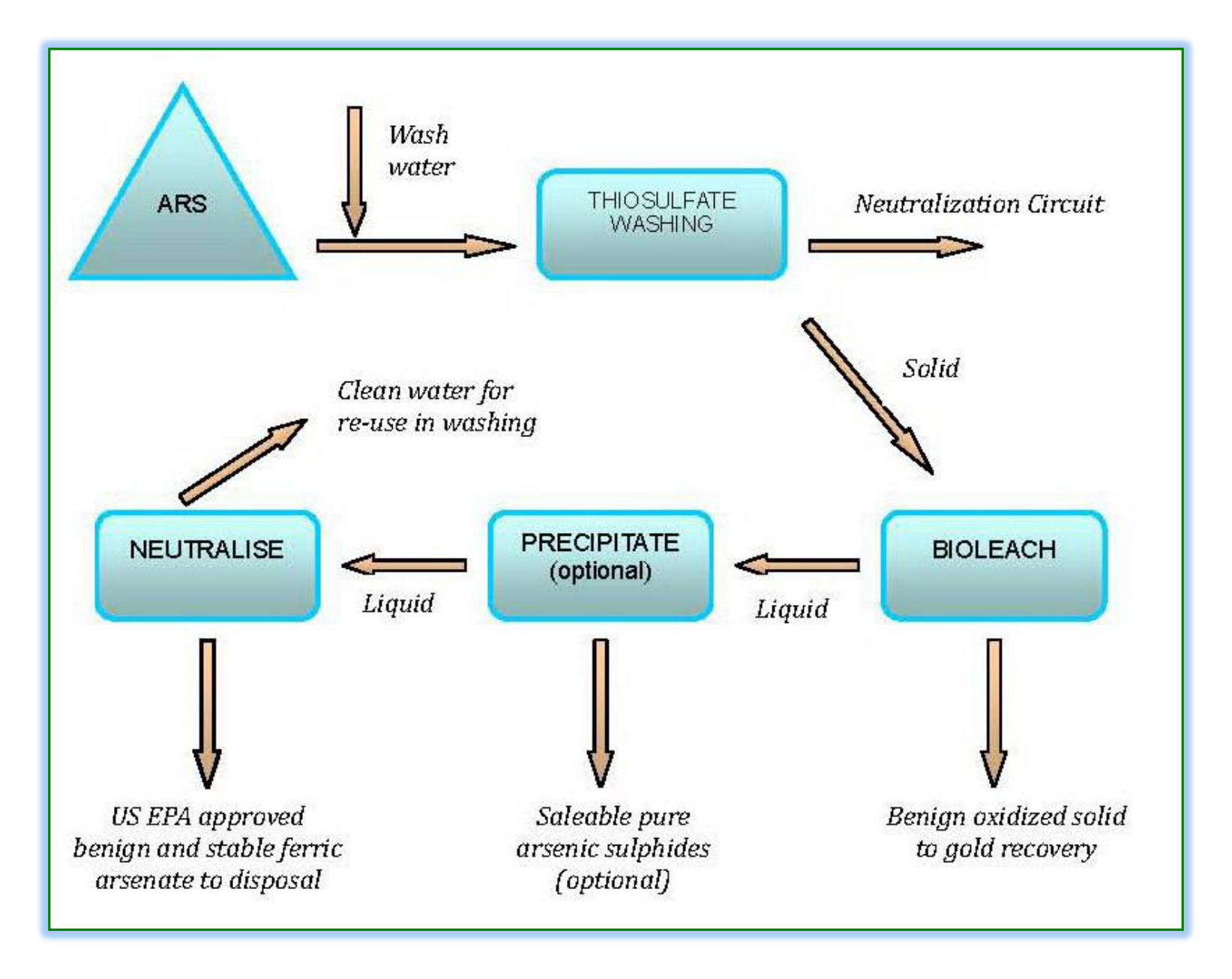
The 2012 PEA for the Snow Lake reclamation project in Manitoba set out a small bacterial oxidation plant that would turn a 9.7 g/t gold residue stockpile into a gold-bearing filter cake and stable ferric arsenate.
The BacTech Snow Lake reclamation project sits within the town of Snow Lake in west-central Manitoba, about 685 km north of Winnipeg, on the former New Britannia and Nor-Acme mine site owned by QMX Gold Corporation. Its target is a gold residue stockpile (GRS) of refractory, arsenic-rich mill tailings that was kept apart from other tailings in the hope that new technology would one day recover the gold. The Province of Manitoba took ownership of the residue in 2004. On April 25, 2011, the province gave BacTech Environmental Corporation the right to remediate it, and BacTech would keep the recovered gold as payment. The preliminary economic assessment, with an effective date of 27 August 2012, describes a development project using BacTech's licensed bioleaching technology. At that date, none of the required permits had been obtained, and the report gives no construction date.
Critical Data
| Parameter | Value | Unit | Notes |
|---|---|---|---|
| Measured resource | 265,000 | tonnes | 9.7 g/t gold and 2.17 g/t silver |
| Feed gold grade | 9.68 | g/t | Process design criteria |
| Feed arsenic content | 21.86 | % | Process design criteria |
| Feed iron content | 25.18 | % | Process design criteria |
| Stockpile moisture | 16 | % | Measured in 2010 drilling |
| Annual feed rate | 39,186 | dry tpa | 46,650 wet tpa |
| Plant feed rate | 100 to 125 | t/d | Front-end loader to feed hopper |
| Regrind target | 75 | µm P80 | Polishing mill and cyclones |
| Bioleach feed density | 10 | % solids | After in-line dilution |
| Bioleach reactors | 6 | Not applicable | 979 m3 working volume each |
| Bioleach residence time | 5 to 6 | days | Total |
| Pyrite oxidation | 95 | % | Minimum design level |
| Arsenopyrite oxidation | 100 | % | Design criteria |
| Reactor temperature | 40 | °C | Controlled by cooling water |
| Neutralization endpoint | 6.5 | pH | Limestone slurry |
| Process building footprint | 600 | m2 | 30 m by 20 m |
Overview
The project has three parts: the stockpile itself, a process facility and a lined storage impoundment for the neutralized arsenic precipitate. The stockpile covers about 180 m by 105 m. In May 2011 BacTech drilled 33 holes into it on a 20 m grid and sent core to Inspectorate in Vancouver for bioleach test work.
The process does not recover gold on site. Bacteria oxidize the sulphides that lock the gold, the oxidized solids are washed and filtered, and the filter cake is shipped elsewhere for precious metals extraction. The arsenic released into solution is precipitated with limestone as ferric arsenate in a matrix of gypsum and ferric hydroxide, and that precipitate goes to the impoundment.
Key Process Stages
Reclaiming the stockpile
A cap of coarse, angular mine waste covers the stockpile. It would be removed in sections so that only part of the residue is exposed to the weather at any time. The 16% moisture in the residue should limit dust, with dust control added if needed. Excavation runs at roughly 135 to 150 t/d for eight months a year to build enough stock for twelve months of plant operation. An end-dump truck carries the material about 600 m to the plant, where it is held in a weatherproof building. Both sites have water management plans to collect snow melt and rain.
Material preparation
The process building holds two grinding mills plus tanks, agitators, pumps and piping in five circuits. A front-end loader feeds residue into a hopper at 100 to 125 t/d. A grizzly removes debris before a repulp tank brings the pulp to 40% solids with wash water. A polishing regrind mill runs in closed circuit with two cyclones. Regrinding freshens the particle surfaces, brings the coarse fraction down to a P80 of 75 µm and removes residual cyanide from the earlier operation, which could otherwise interfere with the bacteria. Cyclone overflow goes to a high rate thickener, and its underflow fills an agitated feed tank with 30 hours of buffer capacity.
Bacterial oxidation
The thickened pulp is diluted in line to 10% solids and split equally between three primary reactors running in parallel. Their combined product then passes through three more reactors in series, with gravity flow in open launders between stages. All six reactors are the same size, about 10.8 m in diameter and 11.8 m high. Acid goes to the primary reactors to balance arsenopyrite oxidation, along with milligram levels of nitrogen, phosphorus and potassium as nutrients.
Fixed speed agitators with hydrofoil impellers mix the three phases, and two low pressure blowers sparge air through a ring main. The reaction gives off heat, so cooling tube bundles in each reactor hold the temperature at 40 °C and also act as baffles. Residence time totals five to six days. The design achieves at least 95% pyrite oxidation and complete oxidation of arsenopyrite and pyrrhotite.
Residue separation
Oxidized pulp goes to a residue thickener. The underflow solids are washed on a belt filter, at a wash water ratio of 3 to 1 and 95% wash efficiency. The cake, about 57 t/d at 90% solids, carries the gold and silver and is shipped off site.
Neutralization and impoundment
Thickener overflow and filtrate carry soluble iron, arsenic and acid. Four 75 m3 agitated tanks in series neutralize this liquor with limestone slurry over six hours, raising it to pH 6.5. The ferric arsenate precipitate is thickened. Clear overflow returns to the process water pond, and the underflow is pumped through one of two HDPE pipelines to a clay and HDPE lined pit next to the existing QMX tailings pond, about 1.4 km northeast. A third line returns reclaimed water to the plant for reuse as bioleach dilution water.
Additional Interesting Data and Summary
The design bioleach liquor reaches about 21.22 g/L arsenic and 23.03 g/L iron, with only 0.04 g/L copper. Two blowers rated at 629 kW each supply about 25,156 Nm3/h of air, assuming 35% oxygen use. Agitators need about 1,293 kW in total.
The precipitate is bulky. The design pumps about 515 t/d of slurry to the impoundment and generates about 3.19 t of precipitate for every tonne of feed. Limestone arrives at 12.5 mm lump size, with four days of storage.
The regrind and bioleach circuits run about 49 weeks a year, while reclamation from the stockpile runs 35 weeks. A winter stockpile of about 11,600 dry tonnes keeps the plant fed when reclamation stops.
Besides the measured resource, the 2011 estimate includes an indicated resource of 9,300 tonnes at 9.2 g/t gold and an inferred resource of 28,000 tonnes at 7.0 g/t gold. The Town of Snow Lake receives a CAD$5/oz gold royalty, and the province takes a 2% NSR once initial capital is repaid. All environmental liability stays with the Province of Manitoba.
Key Processes
- Selective excavation and covered storage of arsenical tailings
- Repulping and polishing regrind to 75 µm P80
- Thickening ahead of a 30 hour feed tank
- Six-reactor bacterial oxidation at 40 °C
- Thickening, washing and belt filtration of oxidized residue
- Off-site extraction of gold and silver from filter cake
- Limestone neutralization to ferric arsenate and gypsum
- Disposal in a lined impoundment with water reclaim
Source: NI43-101 Preliminary Economic Assessment Study for the BacTech Snow Lake Reclamation Project, Snow Lake, Manitoba, Canada, 27 August, 2012.
Project website: BacTech Snow Lake Reclamation Project
