

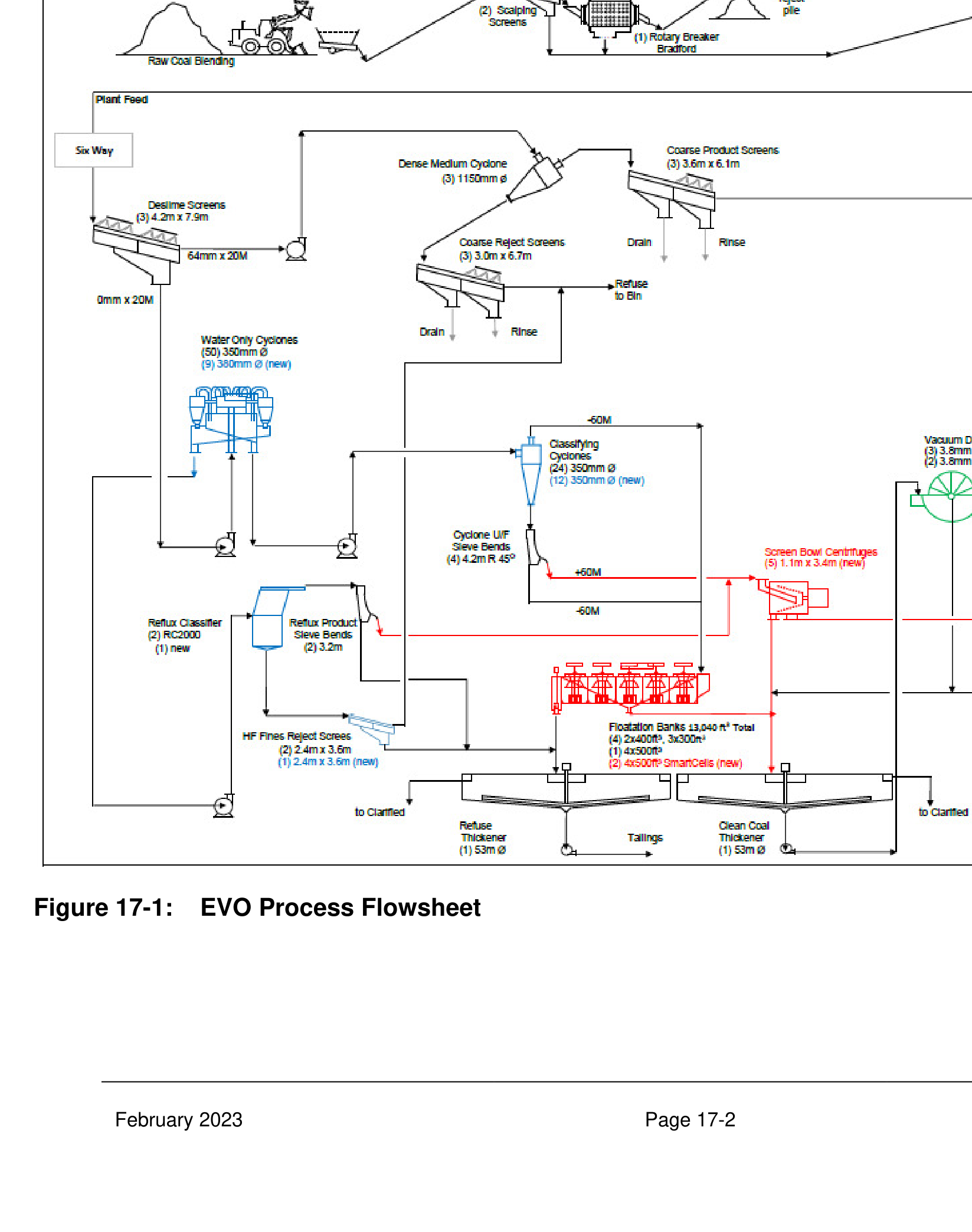
Teck's 2023 technical report on Elkview near Sparwood, British Columbia describes a rotary breaker, heavy media cyclones, water-only cyclones, reflux classifiers and flotation, with a natural gas fluidized bed dryer ahead of rail loadout.
The Elkview Coal Operations lie in the Elk River valley of the East Kootenay region in southeastern British Columbia, about 3 km east of Sparwood. At the effective date of December 31, 2022, Teck Resources Limited held 95% indirectly, with Nippon Steel Corporation and POSCO holding 2.5% each through the Elkview Mine Limited Partnership. Teck Coal Limited was the operator. The current operation began in 1993, and the report says coal reserves support a mine life to 2061, including areas not yet permitted. Elkview produces hard coking coal with a coke strength after reaction of 64 or more, and semi-hard coking coal at 55 to 63. Unit trains carry the product to Westshore Terminals in Delta or Neptune Bulk Terminals in North Vancouver.
Critical Data
| Parameter | Value | Unit | Notes |
|---|---|---|---|
| Operation start | 1993 | Not applicable | Current mining operations |
| Breaker top size | 2 | in | Rock over 2 in rejected |
| Raw coal silos | 4 | Not applicable | Up to 1,800 t each |
| Coarse circuit size | Above 0.8 | mm | Heavy media cyclones |
| Intermediate circuit size | 0.8 to 0.3 | mm | Water-only cyclones and reflux classifiers |
| Fines circuit size | Below 0.3 | mm | Froth flotation |
| Deslime screen capacity | 1,450 | t/h raw | Design maximum |
| Heavy media cyclone capacity | 4,500 | m3/h | Design and average |
| Heavy media SG range | 1.30 to 1.55 | Not applicable | Magnetite in water |
| Flotation capacity | 435 | t/h | Design, 244 t/h average |
| Dryer feed moisture | About 15 | % | Product about 8% |
| Clean coal silos | 4 | Not applicable | Up to 12,500 t each |
| Unit train size | Up to 16,000 | t | Loaded from silo chutes |
| Plant power use | 110,000,000 | kWh/year | Average |
| Fresh water use | 3.5 | Mm3/year | From the Elk River |
Overview
The Elkview plant uses conventional coal preparation equipment and methods. Coarse coal is separated from rock by specific gravity, and the fines by surface properties. Run-of-mine coal first passes a rotary breaker that rejects hard rock. Deslime screens split the plant feed at 0.8 mm. Coarse coal goes to heavy media cyclones. The 0.8 to 0.3 mm fraction goes to water-only cyclones and reflux classifiers, and material finer than 0.3 mm goes to froth flotation. Centrifuges and vacuum disc filters dewater the clean coal, and a natural gas fired fluidized bed dryer removes surface moisture before the coal goes to silos and onto trains.
The flowsheet design rests on test work, study designs and standard industry practice. Yields are modelled from plant feed ash, reject ash and target clean coal ash, and they depend on the seam and the product.
Key Process Stages
Breaker
Raw coal tumbles in the breaker drum. Softer coal breaks below 2 inches and falls through perforated plates to the four raw coal silos, which hold up to 1,800 t each. Rock larger than 2 inches stays in the drum and is rejected. Loaders and trucks haul it to the waste spoils.
Coarse circuit
Deslime vibrating screens send material over 0.8 mm to heavy media cyclones. Clean coal leaves through the cyclone overflow and rock through the underflow. Magnetite, with a solid density of 5.1, is mixed with water to a medium SG of 1.30 to 1.55. A higher medium density lets more material float, which recovers more coal and also carries more ash into the product. Vibrating screens with 0.8 mm openings rinse and dewater the clean coal and the refuse. Wet drum magnetic separators recover the rinsed magnetite for reuse.
Intermediate and fine circuits
Material below 0.8 mm goes to water-only cyclones, with reflux classifiers also treating the 0.8 to 0.3 mm range. Water-only cyclone overflow finer than 0.3 mm goes to flotation. Jet fuel (kerosene) coats the coal particles, and MIBC stabilizes the fine bubbles. Coated coal attaches to the bubbles and rises as froth, while uncoated rock reports to the tailings. Flotation concentrate goes to the clean coal thickener and flotation tailings to the tailings thickener.
Dewatering and drying
Thickened flotation concentrate goes to Peterson vacuum disc filters. Coarser clean coal is dewatered in vibratory basket centrifuges and decanter centrifuges. The filter cake and both centrifuge products feed the thermal dryer, which takes moisture from about 15% to about 8%.
Storage and loadout
Four clean coal silos hold up to 12,500 t each. Unit trains of up to 16,000 t are loaded from chutes under the silos. A dilute flocculant spray on each car keeps dust down in transit.
Additional Interesting Data and Summary
The equipment list gives design capacities against average loads. The water-only cyclones are rated at 1,300 t/h and average 694 t/h. The reflux classifiers are rated at 220 t/h and average 170 t/h. Centrifuges are rated at 1,140 t/h, decanters at 350 t/h and disc filters at 509 t/h. The tailings thickener is rated at 8,313 m3/h, and the clean coal thickener at 4,663 m3/h. Kerosene dosing averages about 2.1 L/min and MIBC about 0.5 L/min.
Water is recycled continuously in the plant. Fresh make-up water covers evaporation in the dryer, moisture in the product and refuse, and water pumped to the tailings pond. The split between fresh water and mine contact water varies from year to year.
The project area covers about 12,412 ha, held in fee simple by the partnership, enough to contain all mining and plant waste in the life-of-mine plan. The report’s history notes that Kaiser Resources commissioned a processing plant in 1969 with an estimated design capacity of over 8 Mt/a.
Key Processes
- Rotary breaking with rejection of rock over 2 inches
- Desliming screens splitting feed at 0.8 mm
- Heavy media cyclones with magnetite recovery by wet drum magnetic separators
- Water-only cyclones and reflux classifiers for 0.8 to 0.3 mm coal
- Froth flotation of fines with kerosene and MIBC
- Centrifuge and vacuum disc filter dewatering
- Natural gas fluidized bed thermal drying
- Silo storage and unit train loadout with dust suppression
Source: NI 43-101 Technical Report on Elkview Coal Operation, British Columbia, Canada, December 31, 2022.
Project website: Elkview Coal Operations
