

The December 2025 technical report on the Donald project in western Victoria, Australia describes a 7.5 Mt/y wet concentrator with scrubbing, deslime cyclones, spirals and a concentrate upgrade plant that floats monazite-bearing material into a rare earth concentrate.
Donald is a planned greenfields mineral sands mine in the Wimmera region of western Victoria, Australia. It covers Mining Licence 5532 and Retention Licence 2002, together 27,155 ha, and is held by Astron Limited through its subsidiary Donald Project Pty Ltd (DPPL). The technical report, prepared for Energy Fuels Inc. with an effective date of 31 December 2025, covers Phase 1 and satisfies both NI 43-101 and the US S-K 1300 rules. It describes a heavy mineral (HM) operation that makes two products: a rare earth element concentrate (REEC) and a heavy mineral concentrate (HMC). Mineral Technologies completed the plant design and the capital and operating cost estimates for the Phase 1 study.
Critical Data
| Parameter | Value | Unit | Notes |
|---|---|---|---|
| ROM feed rate | 1,000 | t/h dry solids | Design |
| Operating hours | 7,500 | h/y | Nominal 7.5 Mt/y |
| Design feed grade | 5.1 | % HM | Operating range 4.0% to 6.5% |
| Feed rate at 6.5% HM | About 900 | t/h | Constrained by back end |
| ROM screen cut | Plus 1 | mm | Coarse gangue removed |
| MUP product size | Minus 10 | mm | Scrubbed and screened |
| MUP relocation | About every 2 | weeks | About 12 hours per move |
| Surge bin capacity | 2 | hours | Ahead of WCP |
| Slimes thickener capacity | 6,000 | m3/h | Slurry |
| Raw HMC from WCP | Nominally 40 | t/h dry solids | Feed to CUP |
| REEC product bin | 30 | t | Dewatered REEC |
| Raw water demand | 2,520 | ML/y | Closed-loop process water |
| Total processing power | About 4.7 | MW | Including MUP |
| Site power | Solar, battery, diesel | Not applicable | Islanded micro-grid |
Overview
The Donald flowsheet is a wet gravity and flotation circuit with no crushing or grinding. A tracked mining unit plant (MUP) scrubs and screens run-of-mine (ROM) ore in the pit and pumps it to the wet concentrator plant (WCP). ROM screens, deslime hydrocyclones and a slimes thickener prepare the feed. Spirals separate the heavy minerals into a raw HMC. A concentrate upgrade plant (CUP) attritions the HMC and floats the rare earth minerals into the REEC. The flowsheet has five process units: the MUP, the screens, cyclones and thickening plant, the WCP, the CUP including the REEC packing plant, and the HMC storage and loading plant.
Key Process Stages
Mining unit plant
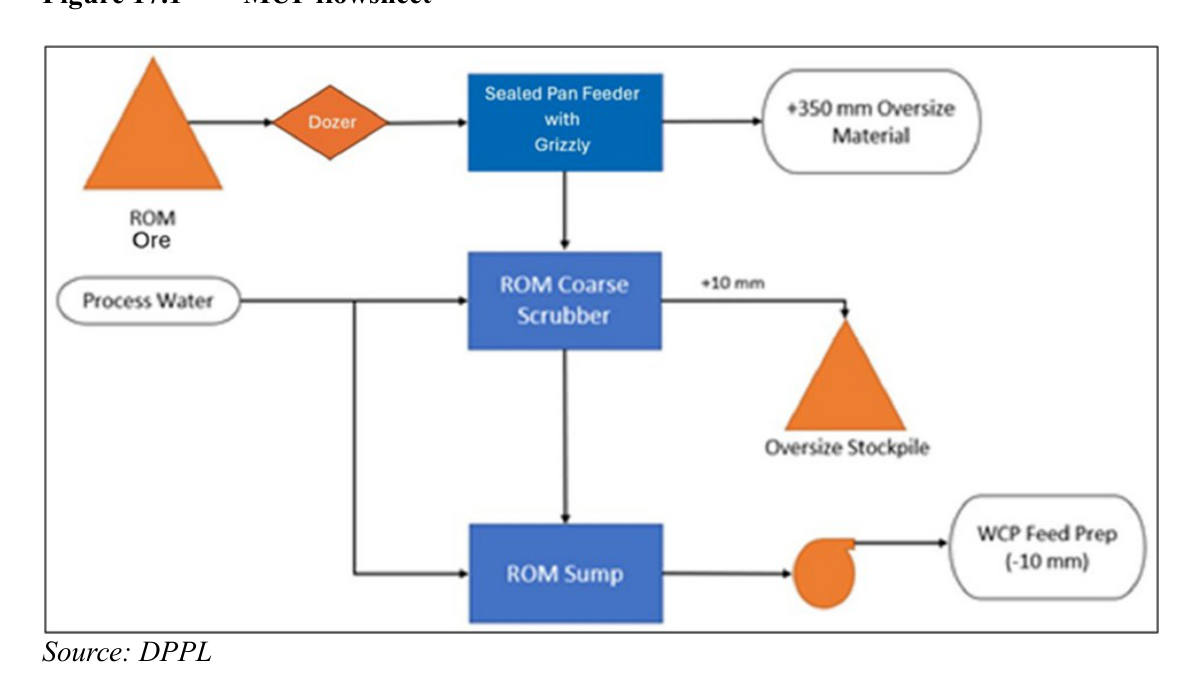
The in-pit tracked MUP is designed to scrub and screen the ROM ore before pumping it to the WCP. It sits within the mining cells, away from the process plant. It is relocatable and moves along the mining path about every two weeks, with each move taking around 12 hours from shutdown to restarting ore washing.
Screening, deslime and thickening
ROM screens at the front of the WCP remove coarse plus 1 mm gangue, mainly silicate, from the minus 10 mm material pumped from the MUP. Without this, the report says, spirals would wear faster and perform worse. Deslime hydrocyclones above the WCP surge bin remove fine slimes before the spiral circuit, and their overflow goes to a slimes thickener that recovers process water. The surge bin gives up to two hours of MUP downtime before the WCP must stop, and its mass flow design lets it restart even when full of solids. Tails dewatering hydrocyclones control the density of tailings pumped to the mine void and recover water.
Wet concentration plant
The WCP separates HM from the screened and deslimed ore, mainly with spirals. MG12 spirals serve the rougher, middlings scavenger and cleaner stages, and HG10i spirals serve the recleaner stage, where the feed is high grade. Pilot testing in 2024 and 2025 confirmed the flowsheet and spiral configurations, with performance in line with or better than earlier results across the range of expected feed variability. Cladding around the spiral level shields the circuit from seasonal high winds.
Concentrate upgrade plant
The CUP separates the minerals that contain rare earth elements from the nominally 40 t/h of raw HMC. The HMC is attritioned so mineral surfaces are well exposed before the flotation circuit. Reagents make the rare earth minerals float with the froth into the REEC, while the remaining HM sink. The CUP building is sealed to keep out rain and wind and to limit personnel access to the product, which contains radioactive mineral particles.
Product storage and loading
The REEC is dewatered into a product bin of 30 t capacity. It is loaded into 2 t bulka bags and placed in half-height lined shipping containers that meet Class 7 radioactive material transport requirements, and the containers are sealed, weighed, labelled and placarded under IAEA regulations. The HMC is pumped to a belt filter, and the washed and dewatered cake goes by conveyor to one of two concrete bunkers, from which a front-end loader fills containers.
Additional Interesting Data and Summary
The process water system is a closed loop linking the WCP, CUP and tailings return water. Raw water demand is 2,520 ML a year, with potable water made on site from licensed bore fields. Total processing power is about 4.7 MW, split roughly as 1.7 MW for the MUP, 1.6 MW for the WCP, 0.5 MW for the CUP, 0.5 MW for water and services, and 0.3 MW for other areas.
Site power comes from a modular micro-grid of solar PV, battery storage and diesel generators, designed for islanded operation. Flocculants are the largest part of the processing consumables cost.
Key Processes
- In-pit scrubbing and screening on a relocatable mining unit plant
- ROM screening and deslime hydrocyclones with slimes thickening
- Spiral gravity concentration in rougher, scavenger, cleaner and recleaner stages
- Attritioning of heavy mineral concentrate
- Flotation of rare earth minerals into a concentrate
- Belt filtration of heavy mineral concentrate
- Tailings dewatering and return to the mine void
Source: Technical Report – Donald Rare Earths and Mineral Sands Project, Victoria, Australia, December 31, 2025.
Project website: Donald Rare Earths and Mineral Sands Project
