

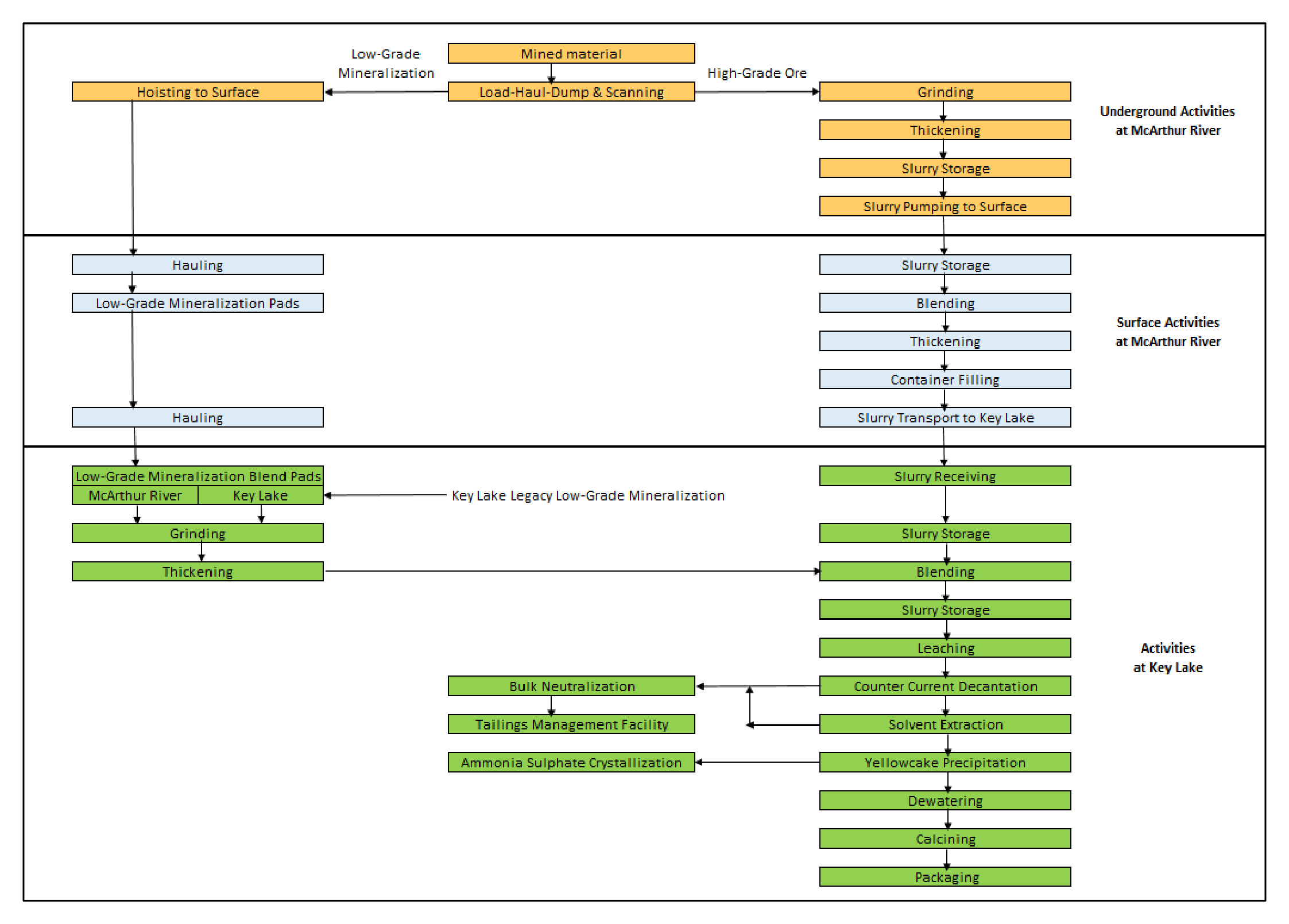
Cameco's 2019 technical report on McArthur River describes underground SAG milling, slurry trucking, blending with low-grade mineralization at Key Lake, acid leaching, eight-stage CCD, solvent extraction and calcined uranium concentrate.
McArthur River is an underground uranium operation in northern Saskatchewan, Canada, owned and reported by Cameco Corporation. The NI 43-101 technical report has an effective date of December 31, 2018 and a technical report date of March 29, 2019, and was prepared by Cameco's internal qualified persons. The report states that production at the operation had been suspended for an indeterminate duration. The mine and its ore processing facilities are licensed to produce up to 25 million pounds of U3O8 a year and were designed for the McArthur River orebody. McArthur River produces two product streams, high-grade slurry and low-grade mineralization, and both go to the Key Lake mill to make calcined uranium ore concentrate.
Critical Data
| Parameter | Value | Unit | Notes |
|---|---|---|---|
| Licensed production | 25 | million lb U3O8 per year | Mine and Key Lake mill |
| Processing capacity for reserves | 18 | million lb U3O8 per year | Current capacity |
| High-grade and low-grade split | 3.0 | % U3O8 | Approved at restart; historically 2.0% |
| Mill feed grade | Nominal 5 | % U3O8 | After blending at Key Lake |
| Underground SAG mill | 4.6 x 2.9 | m | Closed circuit with hydrocyclones |
| Underground thickeners | 13 | m diameter | Two units |
| Ore loadout thickener | 15 | m diameter | Surface |
| Blended slurry grade | Up to 25 | % U3O8 | Maximum, in the ore mix tank |
| Slurry containers | 4 | x 5 m3 per truck train | 12 to 20 truckloads per day |
| CCD thickeners | 8 | Not applicable | Counter-current wash |
| Water treatment capacity | Up to 1,500 | m3/h | 750 secondary plus 750 contingency |
| Product packing | 200 | L drums | Calcined concentrate |
Overview
McArthur River's flowsheet is split between the mine and the Key Lake mill. High-grade ore is slurried, ground and thickened underground. The slurry is pumped to surface, blended and thickened further, then trucked to Key Lake. Low-grade mineralization is hoisted to surface and stored on pads before being hauled to Key Lake. Low-grade mineralization, including legacy low-grade mineralized waste stored at Key Lake, is slurried, ground and thickened at Key Lake and blended with the high-grade slurry to a nominal 5% U3O8 mill feed grade. Leaching through to packaging and tailings disposal all happen at Key Lake.
Key Process Stages
Underground grinding and slurrying
Mined material is scanned and moved by load-haul-dump vehicles. Depending on grade and production needs, it goes directly to the underground grinding circuit, to underground coarse ore storage or to surface. High-grade ore goes to a grizzly-covered hopper with a rock breaker and then by conveyor to a 4.6 m by 2.9 m SAG mill in closed circuit with hydrocyclones and a safety screen. A blind trommel removes tramp metal with a magnet. Hydrocyclone overflow undersize is thickened in a 13 m thickener and stored in an underground ore slurry tank before pumping to surface. Contaminated water and drill cuttings go to two overflow-type surge tanks, with solids re-slurried and returned to the SAG mill.
Surface blending and shipping
High-grade slurry is stored in four air-agitated pachuca tanks and blended to a maximum 25% U3O8 in the ore mix tank. A 15 m ore loadout thickener removes excess water, and the slurry is pumped into truck-mounted containers shipped by road to Key Lake. Low-grade mineralization goes to pads on the surface and then to the Key Lake low-grade blend pads.
Water treatment
Primary treatment uses chemical treatment to control molybdenum, selenium and arsenic, with a lamella thickener, and secondary treatment controls uranium, radium and other metals, with a conventional clarifier and sand filters. Precipitated solids are dewatered in a filter press and mixed with low-grade mineralization for hauling to Key Lake. Treated water is reused where possible and is sampled and released from one of four monitoring ponds only if federal and provincial regulations are met. A pond-based contingency treatment system is tested every year.
Key Lake grinding, leaching and CCD
At Key Lake, the slurry arriving in containers is unloaded by vacuum aspiration into four pachucas. Low-grade material is ground in a SAG mill in open circuit with a sizing screen, and screen oversize goes to a ball mill in closed circuit with two sizing screens. Undersize goes to the neutral thickener. A silica coagulant has eliminated the need to operate the gravity concentrator circuit. The high-grade slurry is blended with neutral thickener underflow, because the original Key Lake facilities were not designed from a radiation protection perspective for McArthur River grades. Uranium is leached in an atmospheric leach pachuca and three continuous stirred tank reactors with sulphuric acid, steam and oxygen. The high pressure autoclave leaching circuit is on stand-by as the current ore is amenable to atmospheric leaching. Eight thickeners in series wash the solids counter-current, and the CCD underflow with minimal residual uranium goes to the Deilmann tailings management facility.
Solvent extraction and product
Clarified pregnant solution is concentrated and purified in solvent extraction, where uranium moves into an organic solvent and then back to ammonium sulphate solution as loaded strip solution. A molybdenum removal circuit treats it. Ammonia precipitates ammonium diuranate, which is thickened, centrifuged and calcined to U3O8 in a multi-hearth furnace and packed in 200 L drums. Excess ammonium sulphate is recovered and sold locally as high purity fertilizer.
Additional Interesting Data and Summary
Processing at Key Lake began in 1983 on ore averaging 2.0% to 3.0% U3O8 from the Gaertner and then the Deilmann open pits. Tailings went first to an above ground facility, and since 1996 to the Deilmann pit. The first high-grade McArthur River ore reached Key Lake in 1999. Upgrades since then include replacing the acid, steam and oxygen plants and the main electrical substation, and commissioning molybdenum and selenium removal circuits.
Raffinate and reverse osmosis reject water go to a bulk neutralization plant, where lime and other reagents precipitate dissolved impurities. The solids are combined with CCD underflow and pumped to the tailings facility.
Key Processes
- Underground SAG milling with slurry thickening
- Slurry pumping, blending and truck transport to Key Lake
- Water treatment with chemical precipitation and filter pressing
- SAG and ball milling of low-grade mineralization at Key Lake
- Atmospheric sulphuric acid leaching
- Eight-stage counter-current decantation
- Solvent extraction, ammonia precipitation and calcining
Source: McArthur River Operation, Northern Saskatchewan, Canada, National Instrument 43-101 Technical Report, March 29, 2019.
Project website: McArthur River Operation
