

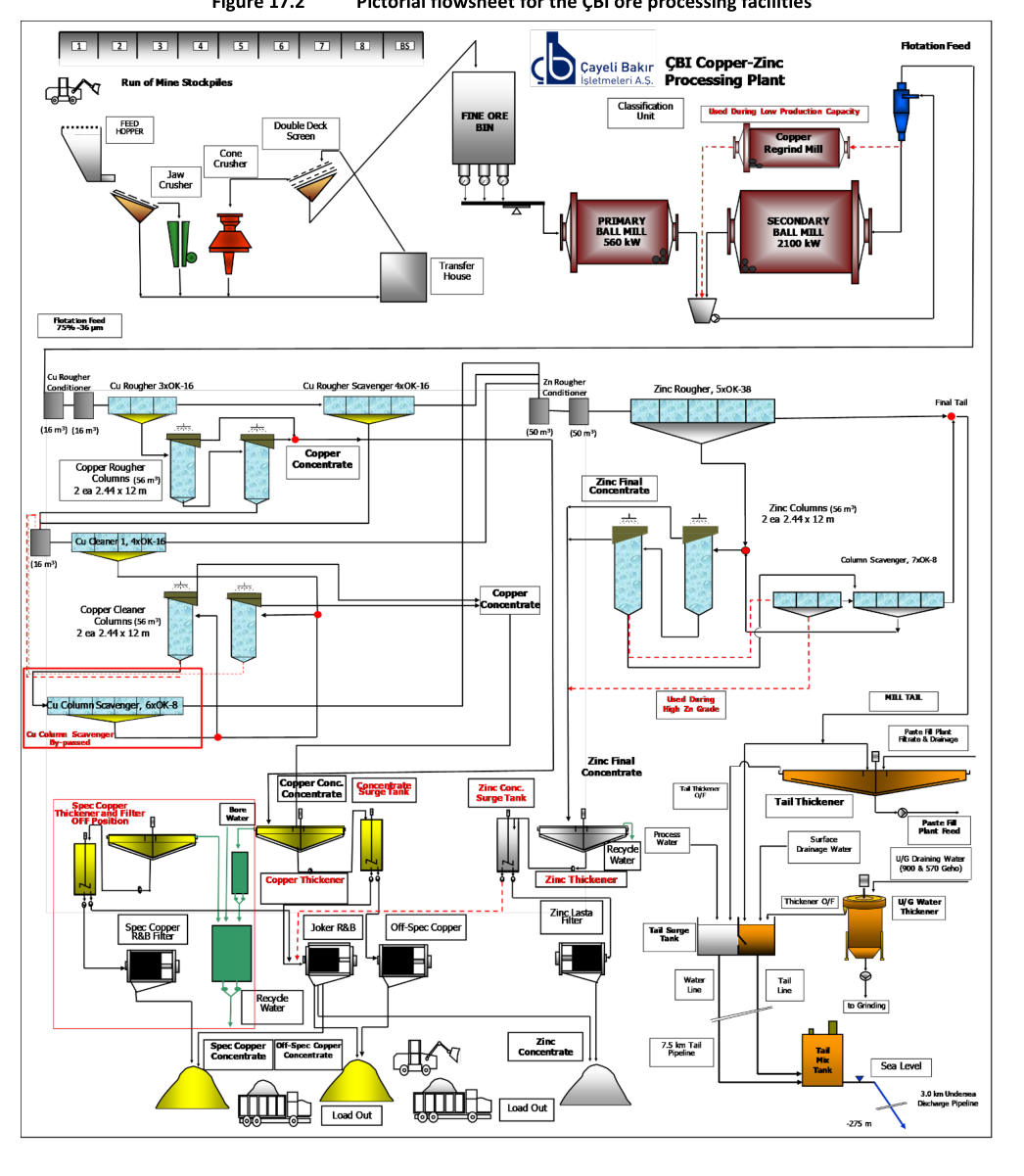
First Quantum's October 2025 technical report on Çayeli Operations describes a plant commissioned in 1994 with jaw and cone crushing, open and closed circuit ball mills, selective flotation with column cleaners, and tailings split between backfill and the Black Sea.
Çayeli Operations is a volcanogenic massive sulphide copper and zinc mine in Rize Province, on the Black Sea coast of Türkiye, owned by First Quantum Minerals Ltd. The NI 43-101 technical report is dated October 2025 and has an effective date of April 30, 2025. The ÇBI ore processing facility was commissioned in August 1994, with the first concentrate in November 1994, and has operated continuously for over thirty years on ore from the Main Orebody. Throughput peaked at 1.34 Mtpa in 2014 and fell as the Main Orebody was depleted, with 691,000 tonnes in 2024. Discovery of the South Orebody extends the planned mine life to 2036, with a mix of Main and South Orebody feed from 2025 and South Orebody ore only from 2028. Plant throughput is planned to peak at about 850,000 tpa in 2027 to 2029.
Critical Data
| Parameter | Value | Unit | Notes |
|---|---|---|---|
| Commissioning | August 1994 | Not applicable | First concentrate November 1994 |
| Peak throughput | 1.34 | Mtpa | Reached in 2014 |
| Throughput in 2024 | 691,000 | t | Main Orebody depleting |
| Planned peak | About 850,000 | tpa | 2027 to 2029 |
| Ore sheds | 8 | Not applicable | One per ore type, covered |
| Jaw crusher setting | 150 | mm | Closed side setting, open circuit |
| Cone crusher setting | 20 | mm | HP 300, closed circuit with screen |
| Secondary ball mill | 2,100 | kW | 4.4 m x 7.2 m, rubber lined |
| Grind size | 50 | µm P80 | 70% passing 36 µm |
| Grinding energy | 21 | kWh/t | Main Orebody; 23.1 for South Orebody |
| Scats | About 3 | % of mill feed | Recrushed off site |
| Copper flotation pH | 11.8 to 12.0 | pH | Lime in the mills |
| Copper columns | 2 + 2 | rougher + cleaner | 12 m tall, 2.44 m diameter |
| Zinc rougher cells | 5 | x 38 m3 | Outokumpu |
| Backfill slurry | 85 | % solids | Filtered, cement added |
Overview
The facility consists of conventional crushing, grinding, selective flotation and pressure filtration circuits, with an online Yokogawa process control system and an SGS Expert System. Ore is stockpiled in covered sheds, crushed in two stages, ground in two ball mill stages, floated for copper and then zinc, and the concentrates are dewatered by thickening and pressure filtration. Final tailings are thickened and pumped to a backfill plant, with the excess discharged into the Black Sea.
Key Process Stages
Ore types and blending
Main Orebody ores are yellow ore, with less than 4% zinc, black ore, with under 5% copper and over 3.2% zinc, and metallurgically challenging clastic ore, with fine sphalerite intergrown with chalcopyrite and high lead. Yellow ores make spec copper and zinc concentrates, while clastic and black ores make a non-spec concentrate high in both copper and zinc that cannot be separated. The South Orebody has footwall yellow ore and black ore, treated in two campaigns: a spec campaign on footwall yellow ore, and a non-spec campaign on a 50/50 blend of high and low zinc black ore.
Crushing
A front-end loader reclaims ore from the eight sheds. A jaw crusher in open circuit at a closed side setting of 150 mm discharges to a double deck screen. The plus 30 mm top deck oversize and the minus 30 plus 18 mm bottom deck oversize go to an HP 300 secondary cone crusher at a closed side setting of 20 mm, in closed circuit with the screen. Undersize is conveyed to a fine ore bin.
Milling
A primary ball mill in open circuit is followed by a 2,100 kW secondary ball mill in closed circuit with hydrocyclones. Both are rubber-lined overflow mills. The primary ball charge is 90 and 80 mm balls and the secondary 40 and 25 mm. One of the four ball mills is no longer operational, and a smaller secondary mill can replace the larger one for softer ores or lower throughputs by swinging the cyclone feed pipe to another set of cyclones. Collector, lime and depressant can be added to the primary mill, which can take three different collectors to suit the ore types. Steel ball consumption was 1.82 kg/t in 2023 and 1.67 kg/t in 2024.
Copper flotation
Feed at 80% passing 50 µm and about 30% solids goes to three 16 m3 Outokumpu rougher cells and four 16 m3 rougher scavenger cells. Rougher concentrate is cleaned in two columns, which make the final spec copper concentrate. Rougher scavenger concentrate and column tails go to a cleaner conditioner and four 16 m3 cells, then two cleaner columns. A cleaner scavenger circuit with six 8 m3 cells has been permanently bypassed. Cleaner tails and rougher scavenger tails feed zinc flotation.
Zinc flotation
Copper tails go to two agitated conditioners, with copper sulphate in the first and collector in the second. Five 38 m3 Outokumpu rougher cells follow, then a cleaner conditioner, seven 8 m3 cleaner cells and two columns of the same size as the copper columns, working in series or in parallel depending on zinc feed grade. Zinc rougher tails go to the final tails pump box.
Tailings and concentrate dewatering
Thickened tailings are pumped to the backfill preparation plant, where they are thickened and filtered to 85% solids and mixed with cement, then pumped underground by positive displacement pumps. Excess tailings are discharged into the Black Sea. Copper and zinc concentrates are thickened and pressure filtered, then shipped in bulk to off-site smelters.
Additional Interesting Data and Summary
Historically two copper concentrates were made from four campaigns: spec, non-spec, bornite yellow and bornite clastic. For the remnant Main Orebody feed in 2025 to 2027 and 2035 to 2036, there will be no separate bornite campaigns, and zinc concentrate will be made only from the non-spec campaign.
The scats from the primary ball mill, about 3% of mill feed, are crushed off site by a contractor from minus 12 mm to 1 to 2 mm and returned to the ore sheds. The plant also has reagent make-up and dosing systems, process water reticulation, compressed air for instruments and valves, and low pressure blowers for the flotation cells.
Key Processes
- Covered ore shed storage and blending by ore type
- Jaw and cone crushing with a double deck screen
- Open circuit primary and closed circuit secondary ball milling
- Copper rougher, scavenger and column cleaner flotation
- Zinc rougher, cleaner and column flotation
- Thickening and pressure filtration of concentrates
- Cemented backfill and marine tailings disposal
Source: Çayeli Operations, NI 43-101 Technical Report, October 2025.
