

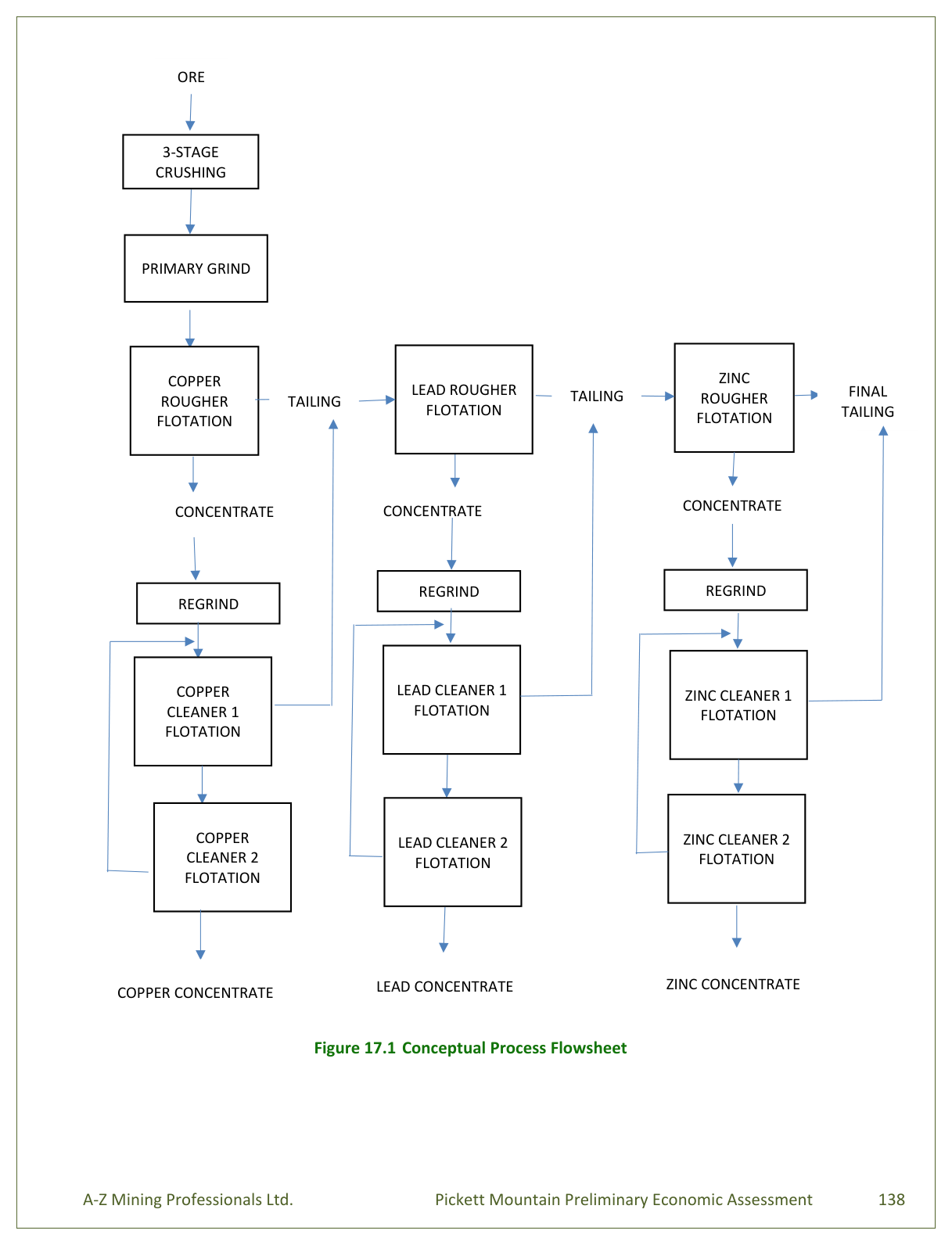
The 2020 preliminary economic assessment for Wolfden's Pickett Mountain project in Maine describes three-stage crushing, a 37 micron grind, four stages of cleaning for each concentrate and filtered tailings, based on 1984 SGS and 2018 RDi test work.
Pickett Mountain is a copper, lead and zinc project in Penobscot County, Maine, USA. Wolfden Resources Corporation is the issuer of the preliminary economic assessment (PEA), which has an effective date of September 14, 2020 and a filing date of October 29, 2020, prepared by A-Z Mining Professionals Ltd. The conceptual process flowsheet and the process design criteria were developed from the metallurgical results in the report. SGS test work in 1984 and RDi test work in 2018 indicated that a sequential flotation process was a better choice than a bulk copper-lead flotation process. The plant is designed to process 1,300 mtpd with an overall availability of 92%.
Critical Data
| Parameter | Value | Unit | Notes |
|---|---|---|---|
| Plant tonnage | 1,300 | dmtpd | 54.2 dmtph average |
| Design plant tonnage | 59.0 | dmtph | Design |
| Plant availability | 92 | % | Overall |
| Crushing feed | 4 | in F80 | Three stages |
| Crushing product | 0.5 | in P80 | To the mill |
| Bond ball mill work index | 10.94 | kWh/st | Design |
| Flotation feed | 37 | µm P80 | Ball mill with SO2 |
| Copper rougher concentrate regrind | 21 | µm P80 | Cleaned two to four times |
| Lead rougher concentrate regrind | 14 | µm P80 | Cleaned two to four times |
| Zinc rougher concentrate regrind | 22 | µm P80 | Cleaned two to four times |
| Copper concentrate grade | Over 25 | % Cu | Target |
| Lead flotation pH | 9.5 | pH | Lime, ZnSO4 and NaCN |
| Rougher residence time | 20 | min | Copper, lead and zinc |
| Filtered product moisture | 20 | % | All products and tailings |
| Process make-up water | About 325 | m3/day | Fresh water |
| Process water recycle | 2,708 | m3/day | Recovered |
Overview
The conceptual flowsheet consists of three-stage crushing to a P80 of 0.5 inch for the milling circuit. The mineralised material is ground to P80 37 microns in a ball mill with SO2. Copper is floated first, then lead, then zinc, with the tailings of one circuit feeding the next. The first-cleaner tailings from each circuit join the rougher tailings to feed the next metal. Final tailings are thickened and filtered because there will be no tailings pond at the site.
Key Process Stages
Copper flotation
The ground product is conditioned with M200 and A325 at natural pH and rougher copper concentrate is floated. Rougher concentrate is reground to P80 21 microns and cleaned two to four times to make a copper concentrate of plus 25% copper. The rougher copper tailing and first-cleaner tailing are combined and sent to lead flotation. The design cleaner residence times for copper are 15, 10, 7.5 and 5 minutes for cleaners 1 to 4.
Lead flotation
Lime, zinc sulphate and sodium cyanide condition the material to pH 9.5, and A325 collector floats the lead minerals. The lead rougher concentrate is reground to P80 14 microns and goes through two to four stages of cleaner flotation to make a marketable lead concentrate. The cleaner residence times for lead are the same as for copper, 15, 10, 7.5 and 5 minutes.
Zinc flotation
The lead rougher and first-cleaner tailings are combined and conditioned with lime and copper sulphate, and zinc rougher concentrate is floated using A343 collector and M200 frother. The zinc concentrate is reground to 22 microns and cleaned in two to four stages. The zinc cleaner residence times are 20, 15, 10 and 7.5 minutes. The zinc rougher and first-cleaner flotation tailings combine to form the final tailing at this stage of study.
Test work basis for the cleaner stages
RDi's open-circuit test work indicates that two to three cleaner flotation stages would be enough to make marketable-grade copper, lead and zinc concentrates, using slightly different reagents than those used in the SGS study. The capital cost, however, is based on four stages of cleaners for each mineral. The design criteria were developed using locked-cycle flotation test No. 46.
Reagents and water
Estimated reagent consumption per tonne of ore is 1.34 kg of SO2, 5.5 kg of lime, 1.6 kg of zinc sulphate, 0.8 kg of sodium cyanide, 0.15 kg of A325, 0.063 kg of M200, 1.15 kg of copper sulphate, 0.05 kg of A343 and 0.10 kg of flocculant. The remaining tailings will be thickened and filtered, with all filtered products at 20% moisture, and the remaining water collected and recycled to the plant. The overall water balance shows about 325 m3 a day of fresh water makeup, because water is lost to the products. If pressure filters are installed, the water requirement would be lower.
Additional Interesting Data and Summary
The report's material balance rests on open-circuit test data. It assumes that 95% of the metal of interest recovered in rougher flotation reports to the final concentrate. Reliable data for lead flotation was not available, so the report assumes the lead concentrate assays 35% lead based on historical data, with lead recovery of about 70%. It states that additional open-cycle and locked-cycle tests are needed to refine the material balance.
The concentrator water balance shows a flotation feed of 1,300 t/d at 30% solids and 3,033 t/d of water. Losses are about 5 t/d of water in the copper concentrate, about 3 t/d in lead concentrate, about 16 t/d in zinc concentrate and about 300 t/d in tailings.
Key Processes
- Three-stage crushing to 0.5 inch
- Ball mill grinding with sulphur dioxide
- Sequential copper, lead and zinc flotation
- Regrinding of rougher concentrates
- Two to four stages of cleaning per mineral
- Tailings thickening and filtration with water recycle
Source: Preliminary Economic Assessment, Pickett Mountain Project, Penobscot County, Maine, USA, October 29, 2020.
Project website: Pickett Mountain Project
