

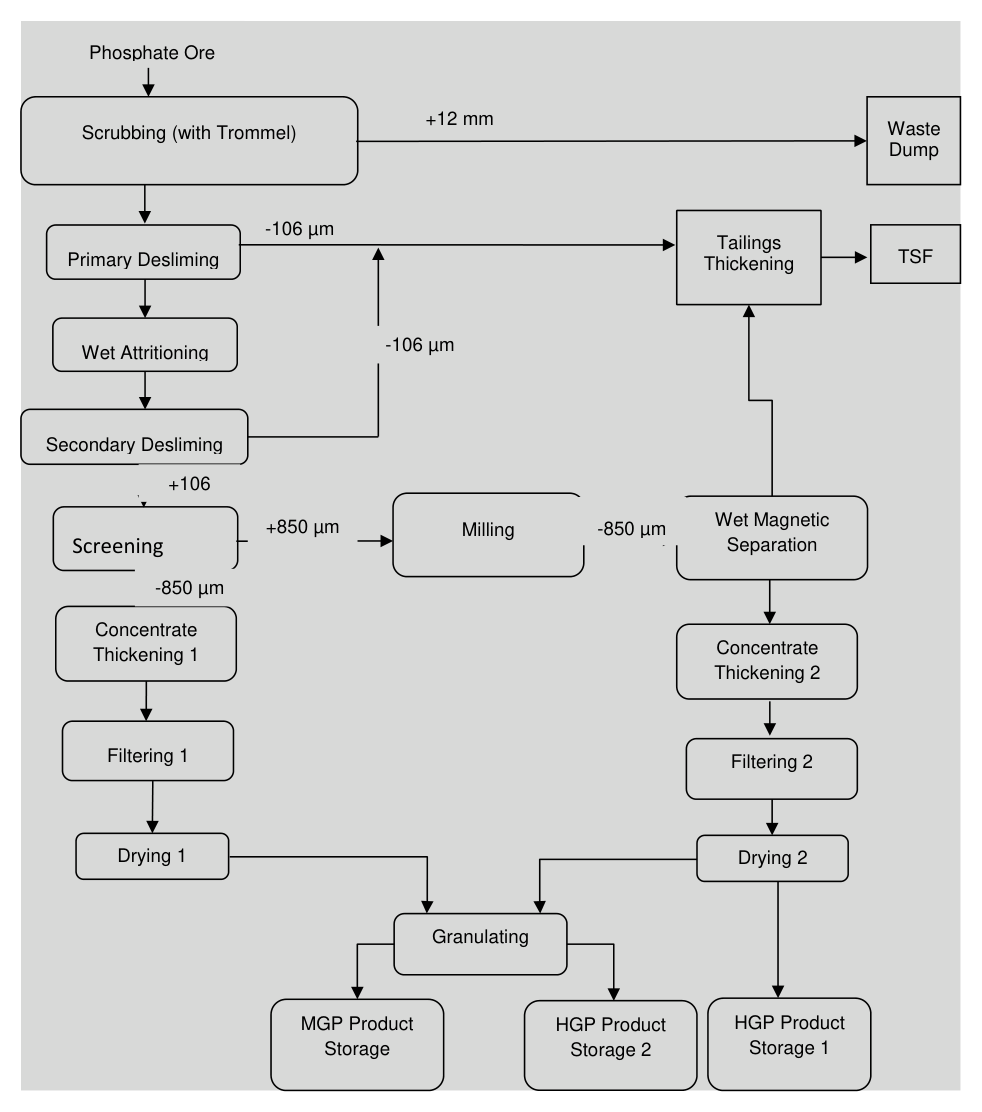
The January 2015 revised preliminary economic assessment for Great Quest's Tilemsi project describes a pilot plant at Dogofry making high and medium grade phosphate for NPK granules, then a 0.5 to 1 Mt/y beneficiation plant near Bourem.
Tilemsi is a phosphate project in Mali, around 120 km north of Gao on the Niger River. The Tilemsi Phosphate Project, Mali, Revised Preliminary Economic Assessment (PEA) was prepared for Great Quest Fertilizer Ltd. with an effective date of January 31, 2015. The report describes two operations. Phase I is a pilot plant at Dogofry, an agricultural town in northern Mali, 1,024 km south west of the Tilemsi mining property and 341 km north east of Bamako. Phase II is a large scale beneficiation plant about 3 km south of the town of Bourem and 1 km from the Niger River. The phosphates are hosted in Middle Eocene laminated clays and silts, in a seam 0.5 m to 2.2 m thick below about 4.0 m of overburden. The total Inferred Resource is estimated at 50.0 Mt at an average grade of 24.3% P2O5.
Critical Data
| Parameter | Value | Unit | Notes |
|---|---|---|---|
| Pilot plant ore feed | 5.4 | t/h dry | 3,251 t per month, 82.8% availability |
| Pilot plant head grade | 28.6 to 29.2 | % P2O5 | ROM to plant above 25% |
| Pilot plant recovery | 89 | % | To high and medium grade phosphate |
| Annual high grade phosphate | 25,200 | t | 35% P2O5 |
| Annual medium grade phosphate | 10,400 | t | 27% P2O5; normal loss 4,400 t |
| Granulated NPK | 96,691 | t/y | Blended with urea and potash |
| Scrubber trommel | 12 | mm | Oversize removed |
| Desliming cut | 106 | µm | Overflow low in phosphate |
| Classification screen | 850 | µm | Oversize to the ball mill |
| Dry mill product | 80 | % passing 300 µm | 1.3 m x 1.38 m mill, 5 tph |
| Phase II feed | 61 / 122 | t/h | Phase 1 / Phase 2 |
| Phase II production | 0.5 / 1.0 | Mt/a | Year 1 / from year 4 |
| Tailings thickener | 8 x 2.5 | m | 22 kW |
| Granule oversize and undersize | Over 4 / under 2 | mm | Bagged separately and returned |
| Raw water | Up to 4 | m3/h | From the Niger River |
Overview
The phosphate ore processing consists of scrubbing and coarse classification followed by attritioning and milling. The process was designed for a recovery of 89% to final product, giving high grade and medium grade phosphate. Pilot plant steps include coarse classification, hydraulic primary classification, water attritioning, hydraulic secondary classification, wet milling and thickening, filtration and drying, dry milling, mixing, granulation and screening, drying and bagging. The high and medium grade phosphates are blended with urea and potash and granulated into NPK products to suit distributor demand.
Key Process Stages
Phase I pilot plant: scrubbing and desliming
Ore at 5.4 t/h goes into a 12 mm trommel drum scrubber with process water. Trommel oversize is stockpiled, and undersize goes to a classification screen that removes plus 4 mm material ahead of desliming. Oversize goes by gravity to the ball mill, while undersize is pumped to a first stage desliming cyclone. Overflow, material under 106 µm, collects in the plant tailings sump, and underflow feeds an attrition scrubber that gently scrubs phosphate minerals free of the remaining clays.
Attrition, milling and classification
The attrition discharge goes to second stage desliming cyclones. Their underflow is classified at 850 µm on a vibrating screen, with undersize pumped to a dewatering cyclone as medium grade concentrate and oversize joining the scrubber screen oversize to feed a single stage ball mill in closed circuit with a classification screen. The mill discharge screen undersize is dewatered by another cyclone to make high grade concentrate. A single split-deck screen serves both duties.
Tailings and dry milling
Slimes from both desliming cyclones, filtrates and dewatering overflow go to a plant tailings tank and a dewatering cyclone ahead of a concrete lined tails storage facility with three bays, filled in two-week cycles. After dewatering, a dry mill takes the minus 850 µm material to 80% passing 300 µm, and a diverter chute sends fines either to granulation or to a hopper for bagging the beneficiated rock.
Granulation and bagging
Granulation needs the 80% passing 300 µm feed. A mixer and two granulators combine medium or high grade phosphate with potash (MOP) solution as binder and additives such as urea, organics, sulphur and borax. A rotary drum dryer cures the granules, and a vibrating screen sizes them, with oversize and undersize returned to granulation. Silos feed a 1 ton bulk bag packer and a 25 or 50 kg bag packer.
Phase II beneficiation
The large scale plant removes plus 12 mm material in a 90 kW, 2.1 m by 5 m drum scrubber at 61 t/h in Phase 1 and 122 t/h in Phase 2. Primary desliming hydrocyclones remove minus 106 µm material, which is low in phosphate and high in iron and aluminium oxides, to an 8 m tailings thickener. Underflow goes to a 37 kW wet attrition unit with three 0.65 m3 cells, then secondary desliming and an 850 µm screen, with wet magnetic separation, thickening, filtering and drying completing the circuit. Hydraulic classification and attrition areas are duplicated at year 4 when production rises from 0.5 to 1 Mt/a.
Additional Interesting Data and Summary
The ore is low in deleterious elements, with cadmium under 1 ppm and uranium under 40 ppm, but rich in iron and aluminium oxides at about 11% combined. The gangue is usually quartz grains of 20 to 50 µm, montmorillonite and kaolinite clays, typically stained by goethite and limonite.
Granulation reagents arrive in 1 ton bulk bags and are stored in a reagents shed with a 22-day holding capacity. They include potash, urea, sulphur, borax, organics, bacteria and colorant.
Key Processes
- Drum scrubbing with a 12 mm trommel
- Two-stage hydrocyclone desliming at 106 µm
- Attrition scrubbing
- Screening at 850 µm and ball milling
- Wet magnetic separation in the large scale plant
- Dewatering, drying and dry milling
- NPK granulation and bagging
Source: Tilemsi Phosphate Project, Mali, Revised Preliminary Economic Assessment, January 31, 2015.
