

West African Resources' April 2015 pre-feasibility study for the Mankarga 5 gold deposit in Burkina Faso describes a heap leach reusing second-hand crushing and stacking equipment, with six fluidized carbon columns, a modular elution plant and on-site doré smelting.
The Tanlouka Gold Project lies about 90 km east-southeast of Ouagadougou, the capital of Burkina Faso, and 20 km south of the regional town of Mogtedo. West African Resources Ltd., listed on the TSX and ASX, commissioned the NI 43-101 Pre-Feasibility Study of the Mankarga 5 gold deposit, which is dated 14 April 2015. The processing concept is an agglomeration heap leach followed by carbon in column adsorption, gold elution, electrowinning and smelting via a modular stripping plant. The plant would process 1,600,000 dry t/y and make an average of 49,000 oz of gold a year at an average head grade of 1.2 g/t, rising to 68,000 oz in the first year. Mintrex Pty Ltd prepared the process design criteria from information supplied by West African Resources and its consultants.
Critical Data
| Parameter | Value | Unit | Notes |
|---|---|---|---|
| Throughput | 1,600,000 | dry t/y | Average gold 49,000 oz/y |
| Average head grade | 1.2 | g/t Au | Design grade for adsorption plant 1.5 g/t |
| First-year gold | Up to 68,000 | oz | Higher grade ore |
| Crushing and agglomeration rate | 261 | t/h | 70% availability, 24 h/day |
| Primary crusher | MMD Sizer | Not applicable | Minus 500 mm in, P80 minus 100 mm out |
| Secondary crusher | Hazemag CVR 1313Vh | 320 kW | P80 minus 10 mm |
| Agglomerator | 3 m x 9 m | Not applicable | 8 rpm, 5° slope |
| Heap lift height | 6 | m | 22 cells, 400 m x 50 m |
| Leach regime | 120 | days | Single stage |
| Net PLS flow | 570 | m3/h | 96% availability |
| Design gold extraction | 90 | % | Heap leach |
| Adsorption columns | 6 | columns | Report text describes tanks 1 to 5 in the cascade |
| Elution column | 4.4 | m3 | Holds 2 t carbon, 140 °C |
| Cyanide solution | 30.5 | % w/w | Mixed on site |
| Ore domains | 4 | domains | 75% from SOX and MOX |
Overview
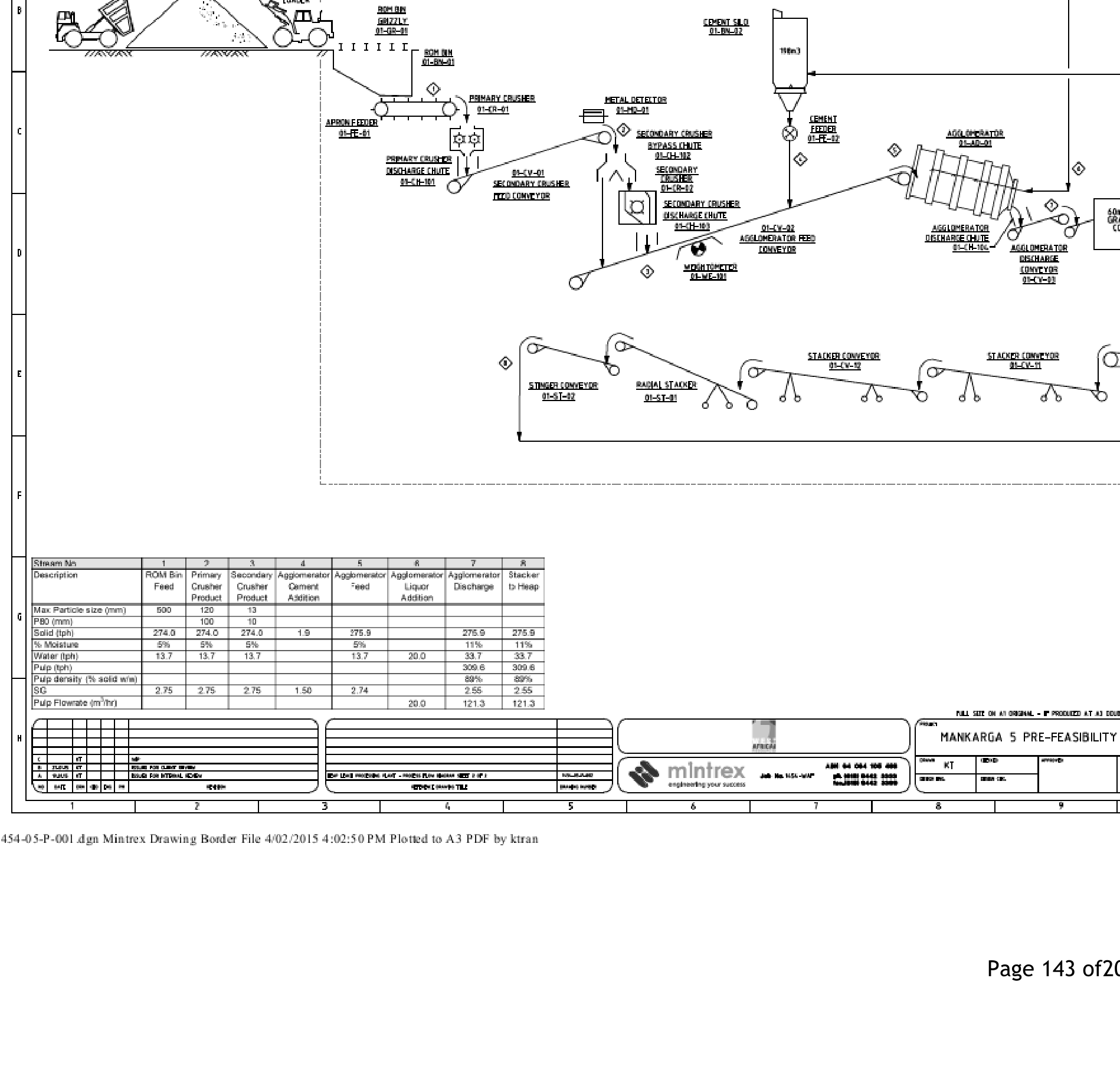
The plant treats four ore domains: weakly oxidised (WOX), moderately oxidised (MOX), saprolite or totally oxidised (SOX) and fresh (FRS). Ore is crushed in two stages and agglomerated with cement and barren leach solution, then conveyed by grasshopper and radial stacker conveyors to the heap. The leach liquor goes to carbon columns, and loaded carbon is acid washed, eluted, and the gold electrowon and smelted. Capacity is based on existing second-hand crushing, conveying and stacking equipment bought by West African Resources, although a new secondary crusher is needed to reach design throughput.
Key Process Stages
Crushing
Trucks deliver run-of-mine ore to separate stockpiles by ore type and grade on the ROM pad, with the target maximum particle size at 500 mm. Oversize is reduced on the pad before a front-end loader feeds a 100 t ROM bin topped by a 500 mm static grizzly. A radar level sensor controls a dump or no-dump signal. A 1 m apron feeder passes ore to the MMD Sizer primary crusher, which makes a P80 of minus 100 mm and a P100 of minus 125 mm. The Hazemag impact crusher makes a P80 of minus 10 mm and a P100 of minus 13 mm, and a weightometer sets the crushing and agglomeration flows.
Agglomeration and stacking
Cement from a silo is fed onto the agglomerator feed conveyor through a rotary valve. Crushed ore and cement enter a Sepro drum agglomerator, where barren leach solution is sprayed into the feed end to wet the cement. The drum has steel liners and low profile lifters. Agglomerate moves over up to six 60 m grasshopper conveyors, a retractable conveyor, two stacker conveyors, a radial stacker of 25 m radius and up to 8 m stacking height, and a stinger conveyor. The stacker places agglomerate to limit compaction and achieve a bulk density that lets solution percolate evenly.
Heap leaching
The heap is split into an estimated 22 cells, stacked upslope with the stacking system retracting as each cell is built. Irrigation starts once enough material is in place to give a buffer zone between leach solution and stacking. The single-stage 120 day leach is designed with the knowledge that lifts 1 and 2 will have longer leaching times. Pregnant leach solution flows to a pond and is pumped to the carbon in column circuit.
Carbon in column adsorption
Solution enters the base of adsorption tank 1 of 35 m3 through a distributor and flows up through a fluidised carbon bed, over a screen at the top and by launder to the next tank, through tanks 1 to 5. Carbon moves counter-current by eductors from tank 5 to tank 1. Barren liquor passes a carbon safety screen and gravitates to the barren leach solution tank. Spillage is collected in an adsorption sump.
Elution, electrowinning and smelting
Loaded carbon is acid washed in dilute hydrochloric acid and rinsed, then dumped into the 4.4 m3 elution column, which holds 2 t of carbon. Caustic cyanide strip solution, heated to 140 °C, goes through the column after a pre-soak of one bed volume and is followed by five bed volumes of hot rinse and one of cold. Elution takes about 8 hours. Two electrowinning cells plate the gold on steel wool cathodes, which are oxidised in a calcine oven and direct smelted with fluxes to doré bars. Barren carbon is regenerated in a kiln and returned to tank 5. The circuit runs 12 hours a day, seven days a week.
Additional Interesting Data and Summary
Cyanide arrives in 20 t shipping containers of 1 t bags and is mixed to 30.5% w/w in a 12.5 m3 tank, then stored in a 25 m3 tank and circulated round a ring main. Caustic soda arrives in 24 t containers of 25 kg bags and is mixed at 50% w/w. Both mixing systems sit in a concrete bunded area with a sump, and emergency cyanide is held in 1 t bags. Cement is delivered by truck and conveyed pneumatically to a silo with a bin activator and rotary valve.
Water comes mainly from a water storage facility built in a seasonal water course to capture wet season run-off. The adsorption plant is a modular design by Como Engineers, and the elution, electrowinning and smelting plant is based on earlier Mintrex projects.
Key Processes
- Two-stage crushing with an MMD Sizer and impact crusher
- Cement agglomeration in a drum
- Conveyor and radial stacker heap construction
- Single-stage 120 day cyanide heap leach
- Carbon in column adsorption
- Acid washing and caustic cyanide elution
- Electrowinning and doré smelting
Source: NI 43-101 Pre-Feasibility Study, Mankarga 5 Gold Deposit, Tanlouka Gold Project, Burkina Faso, Technical Report, April 14, 2015.
Project website: Tanlouka Gold Project (Mankarga 5)
