

The Franklin Project's recovery flowsheet pairs fixed-bed lithium extraction with reverse osmosis, evaporation and two-stage carbonation to reach battery-quality lithium carbonate.
Standard Lithium Ltd. holds the Franklin Project across Hopkins, Franklin and Titus Counties in East Texas, where it would produce lithium carbonate from Smackover Formation brine. The project sits at the preliminary economic assessment stage. The technical report is dated July 20, 2026.
Critical Data
| Parameter | Value | Unit | Notes |
|---|---|---|---|
| Lithium carbonate design capacity | 70,000 | tpa | Design value |
| Operating life | 20 | years | Design value |
| Lithium recovery | 89.25 | % | Design value |
| Lithium in feed brine | 562 | mg/L | Feed composition |
| Calcium in feed brine | 27,437 | mg/L | Feed composition |
| Magnesium in feed brine | 1,549 | mg/L | Feed composition |
| Potassium in feed brine | 11,096 | mg/L | Feed composition |
| Bromide in feed brine | 4,483 | mg/L | Feed composition |
| Boron in feed brine | 474 | mg/L | Feed composition |
| Sodium in feed brine | 80,300 | mg/L | Feed composition |
| Strontium in feed brine | 2,086 | mg/L | Feed composition |
| Total dissolved solids | 382,222 | mg/L | Feed composition |
| Lithium process power demand | 58 | MW | Estimated |
| Bromine process power demand | 2 | MW | Estimated |
| Annual fresh water consumption | 7.5 | million m3 | Current, non-optimized estimate |
| 32% Hydrochloric acid consumption | 142,700 | tpa | Based on 70,000 tpa lithium carbonate |
| 34% Hydrogen peroxide consumption | 8,100 | tpa | Based on 70,000 tpa lithium carbonate |
| 50% Sodium hydroxide consumption, lithium plant | 54,700 | tpa | Based on 70,000 tpa lithium carbonate |
| Sodium carbonate consumption | 142,600 | tpa | Based on 70,000 tpa lithium carbonate |
| Carbon dioxide consumption | 6,600 | tpa | Based on 70,000 tpa lithium carbonate |
| Chlorine consumption | 28,000 | tpa | Based on 50,000 tpa bromine |
| 50% Sodium hydroxide consumption, bromine plant | 12,900 | tpa | Based on 50,000 tpa bromine |
| Sodium bisulphite consumption | 4,700 | tpa | Based on 50,000 tpa bromine |
Overview
The design criteria rest on benchmarking of the more developed SWA Project, which extracts brine of similar composition from the Smackover Formation, together with the results of a treatability study on Franklin brine. Brine arriving at the lithium facility passes through degassing, pH adjustment, filtration and conditioning before it reaches direct lithium extraction.
The extraction step uses a lithium chloride selective sorbent held in fixed bed columns. Loading and elution steps run at set durations and flow rates. Clean water serves as the eluant, and the resulting lithium chloride solution carries over 95% of the lithium from the feed brine with up to a 99% reduction in the concentration of the major contaminant ions.
Downstream purification and concentration bring the solution to a polished lithium chloride brine, which a conventional carbonation circuit turns into crude lithium carbonate. Battery-quality product follows from bicarbonation, ion exchange, decarbonation and carbon dioxide recovery. The plant dries, micronizes and packages the finished carbonate.
The report describes five major process blocks: brine pre-treatment, DLE, concentration and purification, lithium carbonate conversion, and lithium-depleted brine treatment.
Key Process Stages
Degassing and brine conditioning
No gases are anticipated in the brine, hydrogen sulphide included, yet degassing sits in the design as a safeguard. Air stripping moves dissolved gases into an air stream, and a scrubbing stage follows. Degassed brine then passes through a heat exchanger that gives up its heat to cooling water from the cooling tower. pH and oxidation-reduction potential are adjusted afterward.
Filtration
Multimedia filters take out coarse suspended solids and residual oil droplets ahead of the sorbent bed. Ultrafiltration membranes on skid units handle finer solids, with filtration, backflush and clean-in-place steps programmed to hold flow through the membranes. A guard bed follows to remove any iron left after filtration.
Direct lithium extraction
The fixed bed columns load lithium and chloride ions onto the sorbent. Elution with clean water releases them along with lesser amounts of contaminants. The eluate goes to eluate reverse osmosis, and the lithium-depleted brine heads to treatment before reinjection.
Purification and concentration
Eluate reverse osmosis filters and cools the raw lithium chloride solution before multiple stages of higher pressure membranes separate water. Permeate returns to the DLE circuit as eluant. Chemical softening doses the concentrate to precipitate magnesium and calcium, and the separated solids are redissolved and sent to lithium-depleted brine treatment. Ion exchange columns with selective resins then reduce trace calcium, magnesium and boron, with the calcium and magnesium columns ahead of the boron columns. Osmotically assisted reverse osmosis concentrates the treated brine further, and its permeate also returns as DLE eluant. Mechanical vapour recompression evaporation removes more water, and the condensate is recycled to the DLE section.
Lithium carbonate conversion
The first stage draft tube baffle crystallizer reacts lithium chloride with a sodium carbonate solution to form a lithium carbonate slurry. A peeler-type centrifuge dewaters and washes the slurry. The discharged cake is repulped with hot lithium chloride brine from the second stage centrifuge and with reverse osmosis water to make a crude slurry. That slurry is cooled and fed to a bicarbonate reactor, where carbon dioxide under pressure converts the carbonate into soluble lithium bicarbonate. Filtration and fixed-bed ion exchange remove calcium and magnesium. The second stage crystallizer uses steam to convert the bicarbonate back to carbonate, and the carbon dioxide released is recovered for the bicarbonate reactor. This second centrifuge cake is battery-quality lithium carbonate.
Drying, milling and packaging
The carbonate is dried, micronized and conveyed for packaging. After sampling and laboratory analysis it goes into 500 kg or 1,000 kg bulk bags, is palletized and is ready for shipment.
Lithium-depleted brine treatment
Lithium-stripped brine, and potentially bromide-stripped brine from downstream of the bromine tower, is combined with spent reagent streams from the lithium facility. Remaining solids are filtered and dissolved, and pH is adjusted for pipeline transport back to the wellfield for reinjection.
Bromine recovery
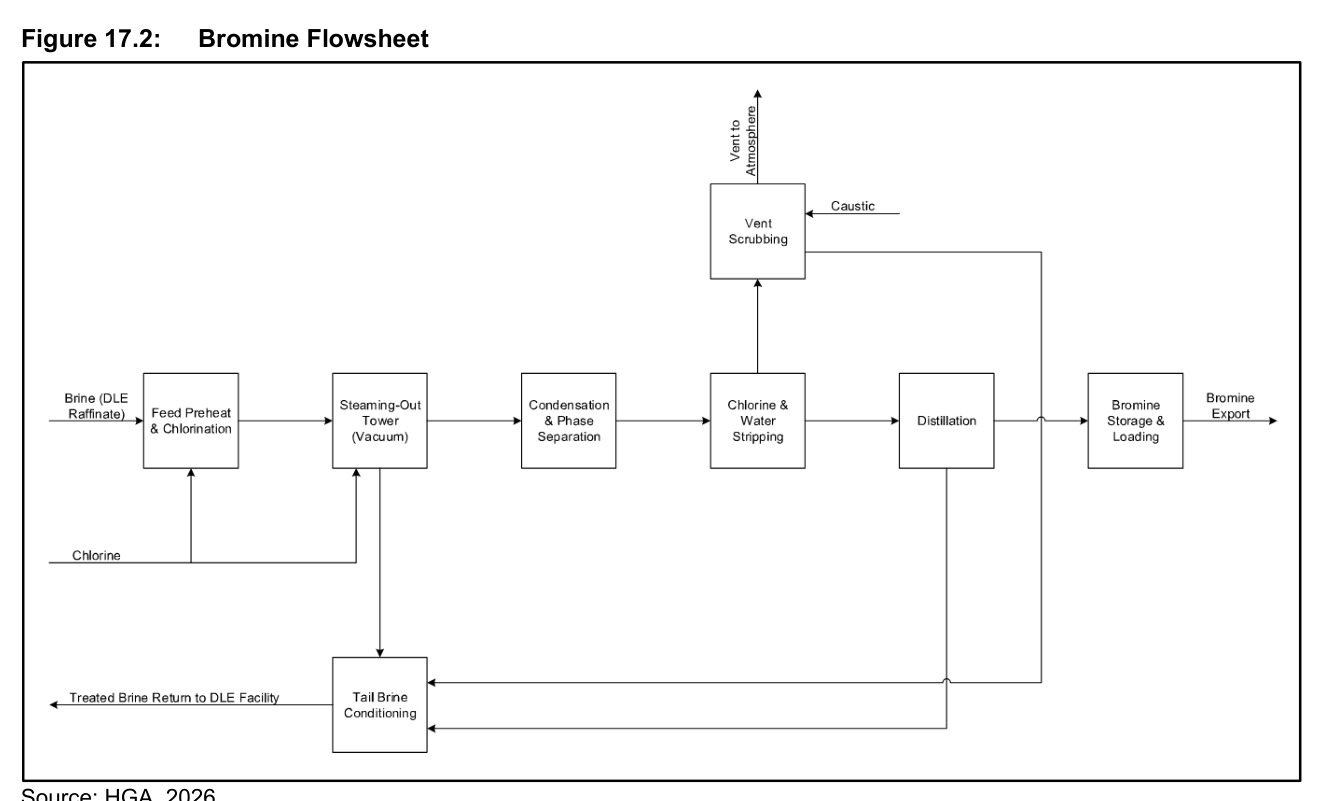
The report contemplates a secondary opportunity case for bromine from lithium-depleted brine, using a steaming-out process. Spent brine is preheated against returning bromide-depleted brine and treated with elemental chlorine, which oxidizes bromide to bromine. The chlorinated brine enters the top of a packed tower under vacuum, and steam sparged below the packing strips the bromine overhead, with additional chlorine sparged inside the packing. About 98% of the contained bromine is removed before the depleted brine leaves the tower bottom. The condensed overhead separates by gravity, with the aqueous phase returning to the tower feed and crude bromine passing forward. Chlorine and water are stripped from the crude bromine, which distillation purifies to a saleable technical grade of at least 99.5% bromine for lined storage tanks and dispatch by road or rail. Two brine-irrigated scrubbers in series recover bromine and chlorine from process vents, and a caustic scrubber converts residual chlorine to sodium chloride and sodium hypochlorite before release. The bromide-depleted brine receives sodium bisulphite to reduce free chlorine and free bromine, then partial neutralization with caustic soda to a pH fit for reinjection.
Additional Interesting Data and Summary
The lithium process facility carries an estimated power demand of 58 MW, and the bromine facility would add 2 MW. The plant design includes water recovery and recycling, and current fresh water consumption is estimated at 7.5 million m3 per year on a non-optimized basis. Fresh water feeds the process, demineralized, cooling, seal, fire and potable water systems.
Reagent figures in the report tie to a production basis of 70,000 tpa lithium carbonate and 50,000 tpa bromine. The design flags both a 20-year operating life and an 89.25% lithium recovery. Every process stage above connects through recycle loops: reverse osmosis permeate and evaporation condensate return to DLE as eluant, and carbon dioxide from the second carbonation stage returns to the bicarbonate reactor.
Key Processes
- Brine degassing by air stripping and scrubbing
- Heat exchange and pH and oxidation-reduction potential adjustment
- Multimedia filtration, ultrafiltration and iron guard bed
- Fixed bed direct lithium extraction with clean water elution
- Eluate reverse osmosis with permeate reuse as eluant
- Chemical softening of calcium and magnesium
- Ion exchange for trace calcium, magnesium and boron
- Osmotically assisted reverse osmosis
- Mechanical vapour recompression evaporation
- Two-stage carbonation with intermediate bicarbonation and ion exchange
- Drying, micronizing and bulk bag packaging
- Lithium-depleted brine treatment and pipeline reinjection
- Bromine recovery, purification and vent scrubbing
Source: NI 43-101 Technical Report Preliminary Economic Assessment for the Franklin Project Located in Hopkins, Franklin, and Titus Counties, Texas, United States, 2026-07-20. Project website: Franklin Project
