
admin

Nash Creek and Superjack Project — Technical Report No. 338

Section 17.0 outlines a preliminary process design flowsheet for the Nash Creek and Superjack Project. The design involves conventional three-stage crushing of run-of-mine material to a size suitable for pre-concentration in a Dense Media Separation (DMS) plant. The DMS facility design is pending further test work, with an assumption that the lower grade 50% of the feed will be rejected as waste with acceptable metal losses.

Nash Creek and Superjack Project — Technical Report No. 338 Read Post »
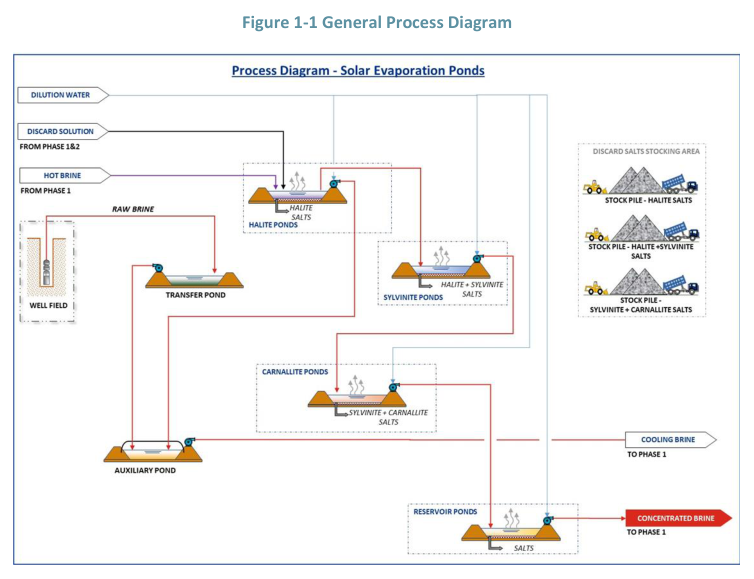
Figure 1-1 General Process Diagram

NI 43-101 Definitive Feasibility Study — Minera Salar Blanco

This NI 43-101 Definitive Feasibility Study outlines the Stage One project for Minera Salar Blanco located in the Atacama Region of Chile. The project focuses on the extraction of lithium from brine resources within the Salar de Maricunga area. The facilities are designed to produce an average of 15,200 tons per year of battery-grade lithium carbonate over a 20-year mine life. The process utilizes solar evaporation ponds to concentrate lithium-rich brine before further purification and precipitation in a production plant.

NI 43-101 Definitive Feasibility Study — Minera Salar Blanco Read Post »

Empire State Mines — 2025 Technical Report

The Empire State Mines (ESM) concentrator, originally commissioned in 1970 and last shut down in 2008, was refurbished in late 2017 and resumed processing mineralization in 2018. The facility is designed to handle 5,000 short tons per day, though current operations run on a reduced schedule of one shift per day, four days per week, processing between 10,124 and 11,375 tons per week. The mine operates underground, with mining production typically not exceeding 2,275 tons per day, projected to peak at 2,800 tons per day in 2028.

Empire State Mines — 2025 Technical Report Read Post »

Magnetic and Electrostatic Separation in Mineral Processing: The Complete Guide

Magnetic and electrostatic separation are essential tools in modern mineral processing, underpinning the production of iron ore concentrates, mineral sands products, and high-purity industrial minerals. This complete guide covers LIMS, WHIMS, HGMS, SLon VPHGMS, dry rare earth separators, HTR and ESP electrostatic separators, and their integration into industrial flowsheets.

Magnetic and Electrostatic Separation in Mineral Processing: The Complete Guide Read Post »

Gualcamayo Property — 2021 Technical Report

The Gualcamayo process facility is designed to treat 25,000 tpd of ore utilizing a combination of open pit and underground mining methods. The ore undergoes primary, secondary, and tertiary crushing before being transported to heap leach pads. Gold recovery is achieved through cyanide heap leaching followed by Adsorption, Desorption, and Refining (ADR) processes, including carbon columns, electrowinning, and doré casting. The facility has undergone sustaining capital updates to automate the ADR plant and recover carbon fines to reduce gold loss.

Gualcamayo Property — 2021 Technical Report Read Post »

Muskowekwan Indian Reserve Project — 2012 Technical Summary Report

This 2012 Technical Summary Report details the recovery methods for the Muskowekwan Indian Reserve Project, operated by Encanto Potash Corp. The project utilizes solution mining techniques to extract potash from underground brine deposits. The processing flow involves heating brine in multiple-effect evaporators to precipitate sodium chloride, which is then removed via clarification and centrifugation. The remaining high-temperature brine is directed to a crystallization circuit to produce potassium chloride.

Muskowekwan Indian Reserve Project — 2012 Technical Summary Report Read Post »

Coricancha Mine Complex — 2018 Technical Report

The 2018 NI 43-101 Technical Report details the recovery methods for the Coricancha Mine Complex. The plant is a base metal polymetallic sulfide concentrator producing Pb, Cu, and Zn concentrates. It also includes a differential flotation circuit for AsPy from pyrite, treated by BIOX® and subsequent cyanidation (CIL) for Au and Ag recovery. The plant was designed in 1999 for 600 tpd and is currently under care and maintenance.

Coricancha Mine Complex — 2018 Technical Report Read Post »

Scroll to Top