

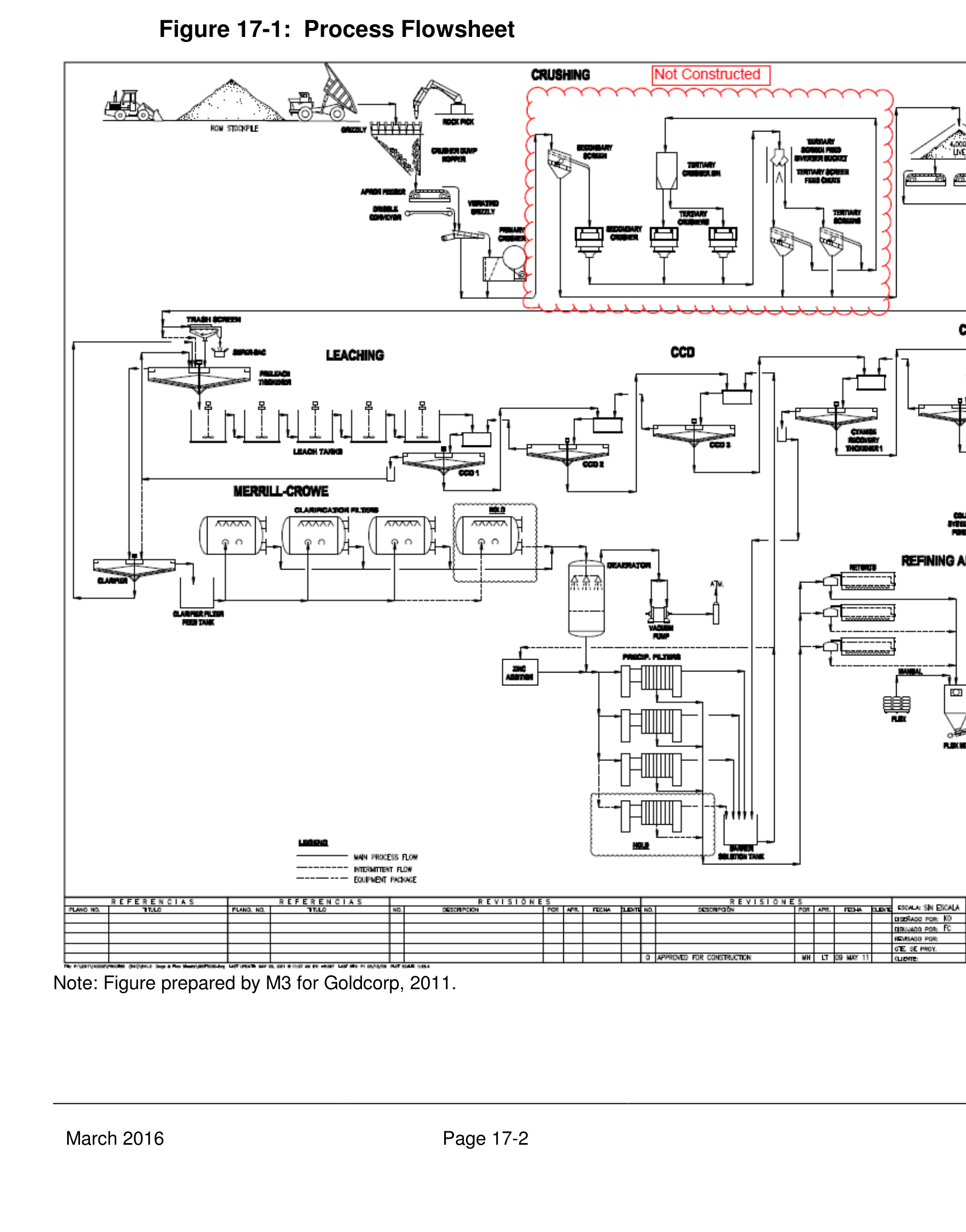
Goldcorp's 2015 technical report on Cerro Negro in Santa Cruz, Argentina describes a 4,000 t/d ball mill, agitated leach, counter-current decantation and zinc precipitation plant that poured its first gold in July 2014.
The Cerro Negro operations lie in the arid Patagonian region of Santa Cruz Province, Argentina, about 345 km by road southwest of Comodoro Rivadavia. Goldcorp Inc. owned the project outright through its indirect subsidiary Oroplata SA. The technical report, effective 31 December 2015, covers low-sulphidation epithermal gold-silver veins mined underground at Eureka and Mariana Central, with Mariana Norte, San Marcos and Bajo Negro to follow and an open pit planned at Vein Zone. The plant first took feed on July 5, 2014 and poured gold on July 25, 2014. It was designed for 4,000 t/d. While the mines ramped up it averaged about 3,590 t/d.
Critical Data
| Parameter | Value | Unit | Notes |
|---|---|---|---|
| First gold pour | July 25, 2014 | Not applicable | Initial feed July 5, 2014 |
| Design throughput | 4,000 | t/d | After mine ramp-up |
| Throughput at report date | About 3,590 | t/d | Limited by ore supply |
| Jaw crusher product | 115 | mm P80 | 125 mm closed side setting |
| Coarse ore pile | 4,000 | t live | 15,000 t total |
| Ball mill | 6.1 m x 10.1 m | Not applicable | Single mill with cyclones |
| Leach feed density | 53 | % solids | After pre-leach thickener |
| Leach tanks | 5 | Not applicable | 3,200 m3 each, 60 hours total |
| CCD thickeners | 3 | Not applicable | 25 m diameter |
| Clarifier | 30 | m | Diameter |
| Detox residence time | 152 | minutes | Two tanks |
| Detox cyanide discharge | Below 50 | mg/L | From 370 mg/L feed |
| Gold recovery | 90 to 95 | % | Varies by zone |
| Silver recovery | 70 to 83 | % | Varies by zone |
| Plant power draw | 5.8 | MW | At about 3,590 t/d |
Overview
Cerro Negro uses a whole-ore cyanide leach and Merrill-Crowe flowsheet. A jaw crusher feeds a covered coarse ore pile, and a single ball mill grinds the ore in closed circuit with cyclones. The slurry is thickened and leached in five agitated tanks. Three counter-current decantation (CCD) thickeners wash the gold and silver out of the leached solids. The pregnant solution is clarified, filtered, de-aerated and precipitated with zinc dust, and the precipitate is retorted and smelted to doré. Three more washing thickeners recover cyanide before the tailings pass a cyanide destruction step and go to the tailings storage facility.
Equipment for a fine crushing circuit was bought but not installed. A gravity concentrator on the cyclone underflow was in place but not running.
Key Process Stages
Primary crushing
Haul trucks or a front-end loader tip run-of-mine ore through a 400 mm grid grizzly into a 60 t dump hopper. A 1,250 mm apron feeder passes the ore to a vibrating grizzly that screens out material finer than 120 mm. Oversize goes to a 1,250 mm by 950 mm single toggle jaw crusher running in open circuit at a 125 mm closed side setting, for a product of 80% passing 115 mm. Crushed ore and grizzly fines are conveyed to the covered coarse ore pile, which holds about 24 hours of mill feed. Two belt feeders reclaim it.
Grinding
The single 6.1 m by 10.1 m ball mill discharges through a trommel to the cyclone feed sump. Barren solution from the cyanide recovery circuit sets the cyclone feed density. Cyclone underflow returns to the mill, and overflow flows to a vibrating trash screen ahead of leaching. Trommel oversize is washed free of fines and cyanide and moved to a stockpile by skid steer.
Pre-leach thickening and leaching
Screened slurry and pregnant solution from the CCD circuit go to a 25 m high rate pre-leach thickener with flocculant and barren solution. The underflow at 53% solids goes to five carbon steel leach tanks, each 16.3 m across and 16.9 m high, with 3,200 m3 working volume, for 60 hours of leaching. Sodium cyanide comes from a ring main, blowers and distribution cones add air, and slaked lime goes into the leach feed and the third tank.
Counter-current decantation
Leached slurry passes three 25 m CCD thickeners. Underflow moves forward and wash solution moves back, gaining gold and silver as it goes. Pregnant solution from the first CCD thickener returns to the pre-leach thickener. Overflow from the pre-leach thickener is the pregnant solution sent for recovery.
Clarification and zinc precipitation
A 30 m clarifier removes suspended solids, recycling part of its underflow to build bed mass. The clarified solution passes a 1,100 m3 feed tank and three pressure leaf polishing filters coated with diatomaceous earth. A tower de-aerates it, then zinc dust and lead nitrate are added to precipitate gold and silver. Three recessed plate filter presses collect the precipitate, which is air dried in the press, retorted to recover mercury and smelted with fluxes in a reverberatory furnace. Slag is crushed in a jaw and roll crusher, and a centrifugal concentrator returns any metal to the furnace.
Cyanide recovery and detoxification
The washed solids from the third CCD thickener pass three more 25 m thickeners in counter-current with process water to recover cyanide and residual metals. The first thickener's overflow becomes barren solution. Underflow at about 55% solids goes to two 283 m3 cyanide destruction tanks. Sodium metabisulphite, air, lime at pH 8.5 and copper sulphate cut cyanide from 370 mg/L to below 50 mg/L over 152 minutes. Tailings are pumped to the tailings facility in a containment channel, and decant water returns to the plant through the same channel.
Additional Interesting Data and Summary
Wells supply about 26% of the process water, reclaim from the tailings facility about 72%, and surplus mine water about 2% since August 2015. A 132 kV line from the national grid powers the site, and a 33 kV network serves the Mariana and Eureka areas.
An ore control group plans the blend of ore from the different mines each month to meet throughput and metal targets. The report found no deleterious elements in the ore. Recoveries come from test work and plant data and vary by deposit.
The reagent list covers zinc powder, sodium cyanide, lime, diatomite, copper sulphate, sodium metabisulphite, coagulant, flocculant, lead nitrate and 3 inch and 5 inch grinding balls. The project pays a 3% provincial royalty on gold and silver value less allowable costs, plus smaller sustainability fund payments.
Key Processes
- Vibrating grizzly scalping and single stage jaw crushing
- Ball milling in closed circuit with cyclones
- High rate pre-leach thickening
- Five-tank agitated cyanide leaching with air sparging
- Three-stage counter-current decantation washing
- Clarification, leaf filtration and de-aeration of pregnant solution
- Merrill-Crowe zinc precipitation, retorting and reverberatory smelting
- Three-stage cyanide recovery washing and SO2/air cyanide destruction
Source: Cerro Negro Operations, Santa Cruz Province, Argentina, NI 43-101 Technical Report, 31 December, 2015.
Project website: Cerro Negro Operations
